

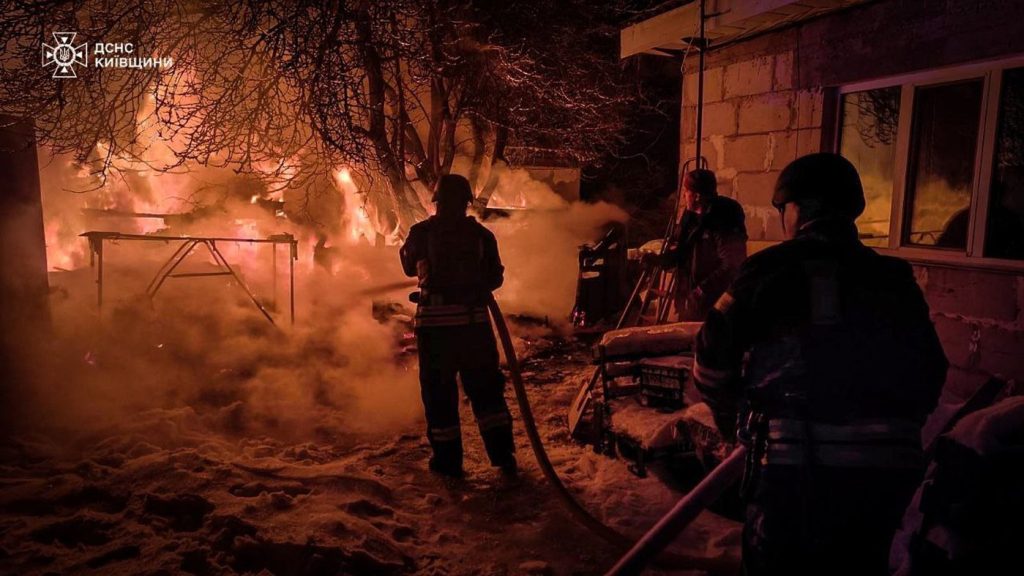
KYIV, Ukraine (AP) - In a significant escalation of hostilities, Russia has launched a second major drone and missile strike on Ukraine within four days, targeting the country's power grid as the war approaches its four-year anniversary. Ukrainian President Volodymyr Zelenskyy reported via social media that nearly 300 drones, 18 ballistic missiles, and seven cruise missiles were unleashed on eight regions overnight.
The northeastern Kharkiv region was particularly hard hit, where a strike on a mail depot resulted in the death of four individuals. Furthermore, hundreds of thousands of households in the Kyiv region found themselves without power amid bitter cold, with daytime temperatures reported at -12 degrees Celsius (approximately 10 degrees Fahrenheit). In the capital, residents contended with icy streets and the pervasive sound of generators.
Just four days prior, Russia executed a large-scale missile attack that involved hundreds of drones and advanced hypersonic missiles, marking only the second instance of such weapon usage in the conflict. This military maneuver appeared to serve as a stark warning to NATO allies of Ukraine, signaling Russia's unwillingness to relent.
On Monday, the United States criticized Russia for what it described as a "dangerous and inexplicable escalation" amidst ongoing efforts to facilitate peace negotiations. At an emergency meeting of the U.N. Security Council, U.S. Deputy Ambassador to the United Nations Tammy Bruce condemned the "staggering number of casualties" and denounced Russia’s increasing assaults on civilian infrastructure, including energy systems.
Throughout the ongoing conflict, Russia has sought to deprive Ukrainian civilians of essential services such as heat and running water during the harsh winter months. Ukrainian officials have referred to this tactic as "weaponizing winter," aiming to weaken public resolve against the full-scale Russian invasion initiated on February 24, 2022.
In Kharkiv, Russian attacks also left ten individuals injured, while six people were reported wounded in the southern city of Odesa. Odesa's regional military administration chief, Oleh Kiper, indicated that energy infrastructure, a hospital, a kindergarten, an educational facility, and several residential buildings sustained damage from the aerial onslaught.
In response to these latest developments, President Zelenskyy has expressed expectations for expedited deliveries of agreed-upon air defense systems from the United States and Europe, alongside new commitments of support to counter the ongoing assault from Russia.
Simultaneously, the Russian Ministry of Defense reported that its air defenses have successfully intercepted eleven Ukrainian drones overnight. Seven of these were destroyed over the Rostov region of Russia, where local governor Yuri Slyusar confirmed an attack on Taganrog, a coastal city approximately 40 kilometers (about 24 miles) east of the Ukrainian border. This attack is part of Ukraine’s recent long-range efforts against Russian military installations.
Ukrainian military sources stated that domestically produced drones successfully struck a drone manufacturing facility in Taganrog, known as the Atlant Aero plant, which designs, manufactures, and tests Molniya drones and components for Orion unmanned aerial vehicles. Explosions and subsequent fires were reported, causing damage to production infrastructure at the site, although independent verification of these claims remains unattainable.
Katie Marie Davies contributed to this report from Manchester, England.








