

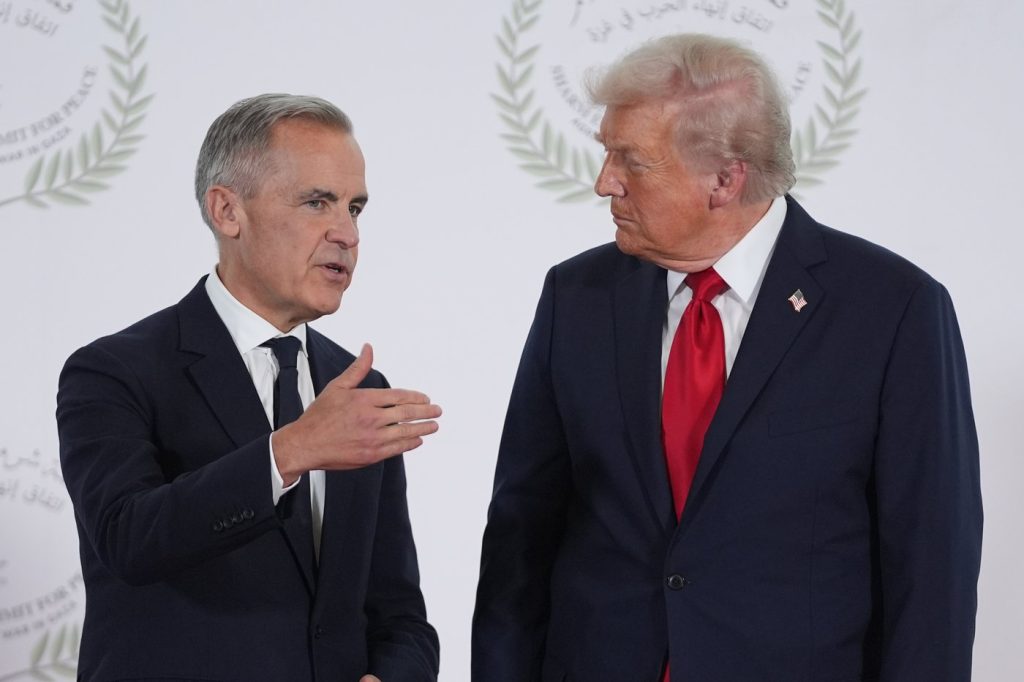
U.S. President Donald Trump has extended an invitation to Canadian Prime Minister Mark Carney to join the newly created "Board of Peace." This initiative is part of Trump's comprehensive 20-point roadmap aimed at the reconstruction and governance of Gaza following the recent conflict. The invitation reflects the significance of collaborative international engagement in addressing post-war recovery efforts.
A senior government official has confirmed that Carney intends to accept the invitation but has not yet communicated his decision to President Trump. Carney's name did not appear on the initial list of board members announced by the White House. This executive board is tasked with overseeing the subsequent phases of governance and rebuilding efforts in Gaza.
On the same day, the Palestinian committee that will govern the territory under U.S. supervision convened for the first time in Cairo. Dr. Ali Shaath, an engineer and a former official from the Palestinian Authority, is leading this technocratic committee. He has pledged to act swiftly to improve living conditions in Gaza, estimating that the process of reconstruction and recovery will take approximately three years, starting with essential needs like shelter.
Under Trump's plan, Dr. Shaath's committee will manage the daily operations in Gaza, while the "Board of Peace," led by Trump, will provide oversight. The board includes prominent figures such as U.S. Secretary of State Marco Rubio, Trump envoy Steve Witkoff, Jared Kushner, former British Prime Minister Tony Blair, Apollo Global Management CEO Marc Rowan, World Bank President Ajay Banga, and deputy national security adviser Robert Gabriel. The specific role Carney is expected to fulfill within this board is currently unknown.
In addition to the Board of Peace, Nickolay Mladenov, a former Bulgarian politician and UN envoy to the Middle East, is designated to serve as the executive board's representative who will oversee day-to-day operations. The White House has also outlined the members of another body, the "Gaza Executive Board," which will collaborate with Mladenov, the technocratic committee, and an international stabilization force to facilitate governance and support reconstruction efforts.
Israeli Prime Minister Benjamin Netanyahu commented on the announcement of the second phase of the Gaza ceasefire, describing it as a "declarative move" rather than indicating genuine progress. The second phase of the ceasefire has raised numerous unanswered questions, such as the deployment of an international security force to enforce the ceasefire, the reopening of Gaza's southern Rafah border crossing, and the details surrounding the disarmament of Hamas.
Amid ongoing violence and significant hardships, many Palestinians in Gaza have expressed skepticism regarding the changes promised. Since the ceasefire between Israel and Hamas commenced in October, more than 450 casualties have been reported, including over 100 children, according to Gaza's Health Ministry. Overall, the ministry asserts that approximately 71,441 Palestinians have been killed since the beginning of Israel's military offensive, while Israel disputes these figures and has not released its own casualty statistics.
This ongoing conflict marks the third consecutive winter since the onset of hostilities between Israel and Hamas, which began on October 7, 2023, when militants launched an incursion into southern Israel, resulting in the deaths of around 1,200 people and the abduction of 251 individuals. The overall situation remains tense and complex as local and international leaders grapple with the dual challenges of immediate humanitarian needs and long-term governance in Gaza.








