

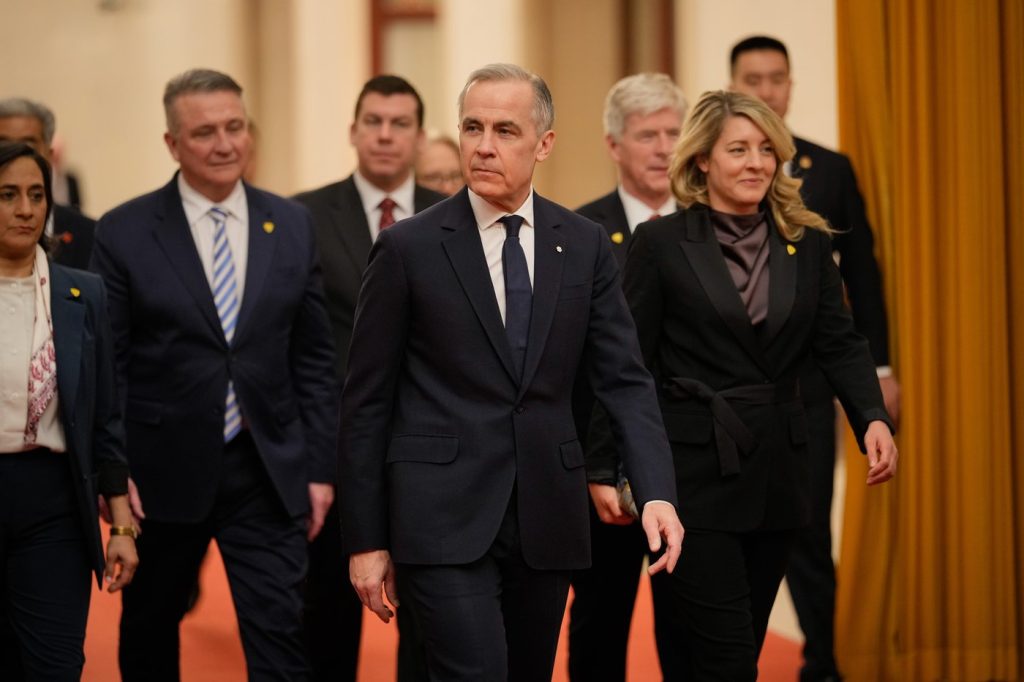
Mark Carney, the Canadian leader, recently met with China's President Xi Jinping in Beijing, marking a significant moment in the evolving relationship between Canada and China. This meeting comes after nearly a decade of stalled relations, with both leaders acknowledging the impact of U.S. President Donald Trump's administration on their discussions. Trump’s provocative statements and policies have played a substantial role in shaping the atmosphere in which these diplomatic talks took place, even from 8,000 miles away.
Canada's reengagement with China, its second-largest trading partner after the United States, reflects a strategy dubbed "strategic autonomy." This concept indicates that Canada, traditionally closely aligned with the U.S., is seeking to establish additional pillars for its international relations due to recent tensions with Washington. Carney emphasized the need for a diversified economy, one that can withstand global trade disruptions and lessen reliance on the American market.
During this pivotal visit, tangible agreements were reached. Canada announced it would eliminate its 100% tariff on Chinese electric vehicles (EVs) in exchange for reduced tariffs on Canadian agricultural products. Specifically, Canada will impose a 6.1% tariff on an initial annual cap of 49,000 Chinese EVs, increasing to about 70,000 over five years. In turn, China agreed to cut its tariff on canola seeds, a major Canadian export, from 84% to approximately 15%. Despite the lack of detailed disclosures from the Chinese side, analysts have characterized these outcomes as mutually beneficial amidst a challenging geopolitical landscape.
This deal signifies a strategic move for Canada, especially after a year of harsh treatment from the United States under Trump's administration. Analysts noted that the agreements, though preliminary, demonstrate political astuteness and could be seen as a subtle way for China to create a rift between Canada and the U.S. The presence of nearly 2 million Canadians of Chinese descent and the cultural ties that bind the two nations play an important role in how Beijing approaches its relations with Canada.
As China positions itself as a counterbalance to U.S. dominance, it is gaining a strategic partner in Canada at a time of increased uncertainty. China's official Xinhua News Agency referenced the importance of Canadian ties, particularly as both countries navigate the complexities of American priorities under Trump’s governance. Both Xi and Carney were careful in their language during the meeting, hinting at a delicate rapprochement while emphasizing the need for stability in turbulent times.
Carney acknowledged that Canada's relationship with the U.S. is more complicated than with China but suggested that recent interactions with Beijing have become more predictable. While it remains unclear what long-term effects Carney's visit will have, the current landscape suggests that Xi's government has found a stronger ally in North America than it had a week prior.
In response to Carney's dealings, Trump expressed approval, stating that negotiating a trade deal with China was beneficial for Canada. However, given Trump's tendency to shift focus rapidly, the future dynamics between Canada, the U.S., and China remain uncertain. For now, though, the evolving context indicates that Canada is pursuing a path that provides it with greater agency and options on the global stage.








