

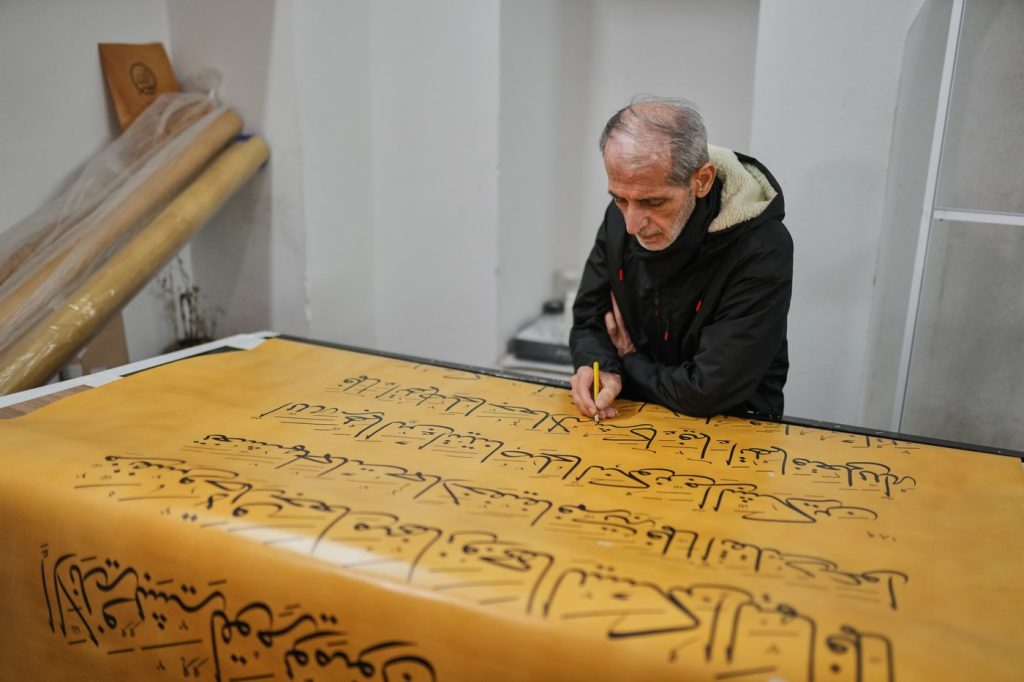
ISTANBUL (AP) – Iraqi calligrapher Ali Zaman expresses immense pride in his monumental achievement: a colossal handwritten manuscript of the Quran that has taken him six years to complete. This extraordinary work comprises 302 double-sided scrolls, each measuring 4 meters (13 feet) in length and 1.5 meters in width. The sheets of this manuscript, which have the appearance of heavy parchment, were custom-crafted for Zaman using a mixture of traditional materials, including eggs, corn starch, and alum.
Zaman, who is 54 years old, shared his deep emotional connection to this project, stating, "Anytime I think of this Quran, it gives me a very nice feeling that the mighty God gave me the life to be able to finish this thing and complete it. I feel very proud." He spoke to The Associated Press at a mosque in Istanbul where the manuscript is currently housed.
The art of Islamic calligraphy is held in high esteem within the Muslim world, serving not only to preserve but also to enhance the beauty of the Quran. Additionally, this art form has historically been used to adorn mosques, palaces, and manuscripts. The tradition flourished in Turkey during the Ottoman era, supported by the state, leading to the development of distinct calligraphic styles.
Today, Istanbul stands as a significant center for this art, known locally as "hat." Art expert Umit Coskunsu noted the influence of Islamic traditions, which typically restrict the depiction of human figures. As such, calligraphy has emerged as a primary means of artistic expression. Coskunsu describes the art of "hat" as more than mere calligraphy; it is perceived as a form of worship, saying, "The art of hat is not just calligraphy; it is seen as a means of worshipping God and coming closer to Him."
Born in Ranya, a town in the Sulaymaniyah governorate of Iraq's northern semi-autonomous Kurdish region, Zaman relocated his family to Istanbul in 2017. This move was motivated by his desire to pursue his Quran project and refine his calligraphic skills, as he believes the art is more respected in Turkey than in his homeland. Zaman began his journey into Islamic calligraphy at approximately 12 years of age, when he was first introduced to the art form in Iraq. He reflected, "The art of calligraphy was very attractive to me; I felt that I could find my soul in it."
Every sheet of Zaman's manuscript is entirely handwritten. Over the span of six years, he dedicated himself to this laborious task, working from dawn until dusk in a small room designated for him at the Mihrimah Sultan Mosque in Istanbul. The manuscript is recognized as one of the largest in the world, although it has not yet received official acknowledgment. According to Guinness World Records, the largest printed Quran was achieved by the Holy Quran Museum in Mecca, Saudi Arabia, in March 2025.
Rekar Zaman, Ali Zaman's son, remembers the long periods of absence while his father was engrossed in this ambitious project. He said, "We only saw him when we would bring him food or when he came home at night to sleep. Thank God, we see more of him now." The completed manuscript is carefully stored in stacked scrolls, safeguarded from dust and moisture at the mosque where it was created.
Zaman's ultimate aspiration is for the manuscript to be purchased by someone who can display it publicly. He expressed his desire saying, "I want for this Quran to be in a country—in a museum, or in a place that is special for calligraphy—where it can be appreciated and valued."








