

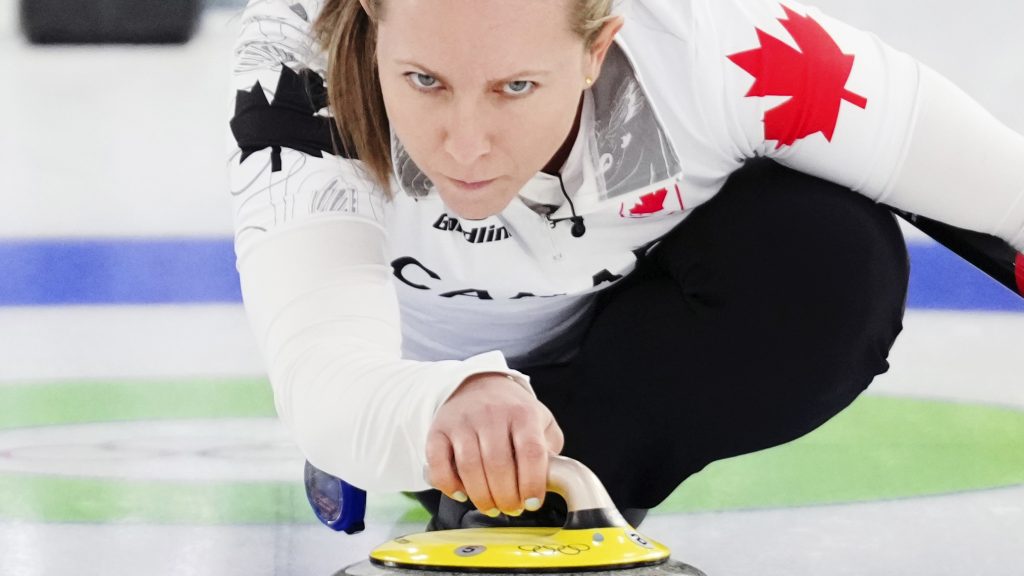
The controversial double-touch incident in curling at the Winter Olympics has escalated, sparking intense discussions among players and officials alike. This incident occurred during the match where Canada’s Rachel Homan faced Switzerland in the first end on Saturday. Homan’s first stone was removed by officials due to a rules violation, which she vehemently contested.
In a moment captured by broadcast microphones, Homan expressed her disbelief at the decision, stating, “Like absolutely not. Zero per cent chance (she double-touched the rock).” Despite her protests, officials maintained their stance that she had indeed violated the rules, leading to the removal of her stone from the ice. This forced Homan to make an open draw for one with her final stone, which she successfully executed.
Following the game, Homan confronted the officials regarding their decision. She remarked, “It’s the same throw as my (first) one, it’s unreal.” Canada ultimately suffered a disappointing 8-7 loss in the extra end, and this defeat brought Team Homan's record to a challenging 1-3. Expressing her frustration more candidly in an interview with CBC Olympics after the match, she stated, “Yeah it’s frustrating, the officials getting into the game that they have no business getting into.” Homan also emphasized how the incident rattled her focus as they fought hard but narrowly lost, adding, “It’s just a shame that had to happen.”
Homan elaborated further on the incident, saying, “They said I touched the stone after I let it go, which is so far from the truth, it’s crazy. Just making something up, I don’t know. We have the Maple Leaf on our back, I’m not sure.” This allegation of double-touching added another layer of controversy to an already tense environment surrounding the competition.
The controversy coincided with another incident from the previous day involving Canada’s Team Brad Jacobs and Sweden’s Team Niklas Edin. During that match, Edin’s third player, Oskar Eriksson, accused Jacobs’ third player, Marc Kennedy, of double-touching a stone. Despite multiple discussions with officials, no action was taken, leading Eriksson to confront Kennedy in a heated exchange after the ninth end, which captured significant attention within the curling community.
In response to the growing tensions and series of disputes, World Curling issued a statement on Saturday, clarifying the rules surrounding stone delivery. The organization reiterated that “During forward motion, touching the granite of the stone is not allowed,” and emphasized that such a violation would result in the stone being removed from play. Reference to Rule R.5 (d) of the curling rule book was made, stating, “The curling stone must be delivered using the handle of the stone.”
This string of incidents has stirred strong emotions among players, raising questions about the consistency of officiating and the interpretation of rules in high-pressure situations. As the Winter Olympics continue, the implications of these controversies may reverberate throughout the tournament, affecting not only the affected teams but also the broader competitive landscape of curling.








