

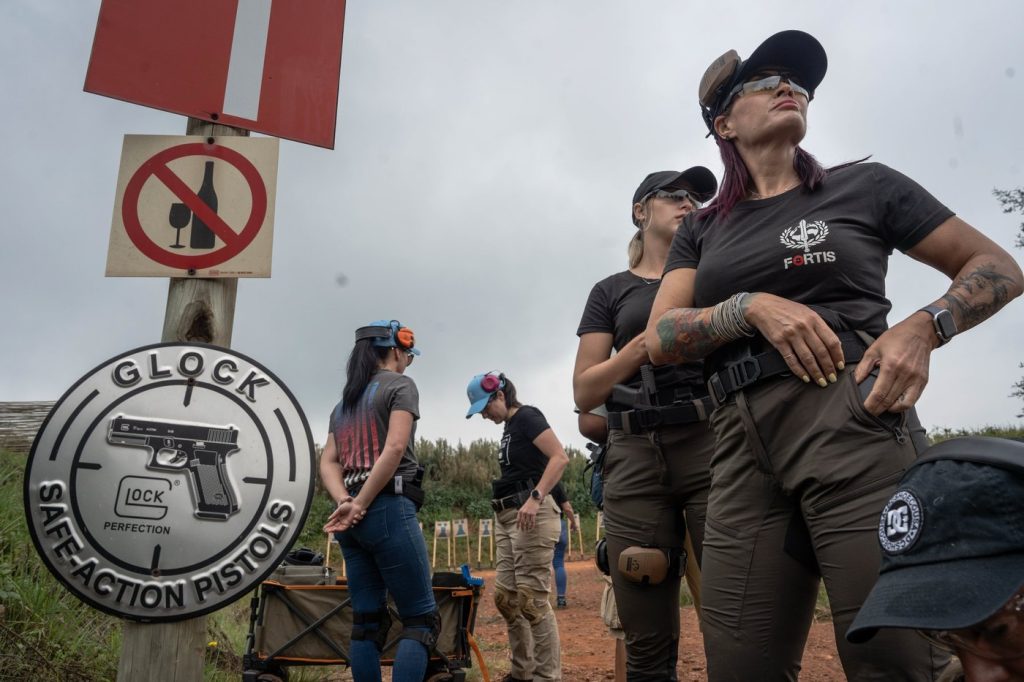
In Bronkhorstspruit, a town near Pretoria, South Africa, a group of girls and women participate in firearm training at the Lone Operator shooting range. Under the guidance of female instructor Claire van der Westhuizen, the participants, some as young as 13 and others up to 65, practice shooting 9 mm pistols to bolster their self-defense skills. This initiative comes in response to the alarming rates of gender-based violence in South Africa, a crisis severe enough to be declared a national disaster by the government in November.
The decision to train in firearms reflects the urgency of the situation. Femicide rates are among the highest globally, with statistics from U.N. Women indicating that more than 35% of women aged 18 and older in South Africa have faced physical or sexual violence. Most of these incidents involve intimate partners. Sunette du Toit, a 51-year-old grandmother, explains that her experience of a home invasion by five men compelled her to gain confidence through firearm training, allowing her to feel safer in public and within her own home.
Firearm ownership in South Africa is strictly regulated. Individuals seeking to own a gun for self-defense must be over 21, pass proficiency tests, and undergo comprehensive background checks. In addition to firearm training, various self-defense courses are emerging across the country. In Johannesburg, for instance, 33-year-old Tatiana Leyka has taken up jiujitsu, aware of the entrenched issues of gender-based violence. She notes the increasing importance of being able to defend oneself amid rising violence towards women.
The statistics are dire: approximately 15 women are murdered daily due to gender-based violence in South Africa, with one in three women experiencing sexual abuse or harassment. Mpiwa Mangwiro-Tsanga, a policy development and advocacy manager at Sonke Gender Justice, emphasizes the severity of the situation, comparing it to countries in conflict. President Cyril Ramaphosa's declaration of gender-based violence as a national disaster follows persistent pressure from women's advocacy groups, stressing the socio-economic inequalities and deeply ingrained patriarchal attitudes contributing to this crisis.
The government's declaration enables the allocation of funds to combat gender-based violence. However, activists criticize the disparity between policy and implementation, highlighting that past initiatives have failed to yield tangible improvements. The lack of women's shelters and services exemplifies the inadequacies of South Africa’s response to this epidemic. Mangwiro-Tsanga points out that the justice system often supports perpetrators more than survivors, with the conviction rate for rapes in 2021 standing at a troubling 8%, meaning many cases are not prosecuted effectively.
Faced with inadequate support from authorities, many women in South Africa are taking matters into their own hands, often training in secrecy to avoid potential backlash from partners. Michael Palin, a jiujitsu gym manager, notes that some women feel compelled to disguise their attendance at training sessions. Marguerite Hershensohn, a 49-year-old beauty therapist, appreciates that her daughter Nika is learning self-defense through firearms rather than solely relying on police assistance, acknowledging the limit of their availability in times of need.
Although these training programs foster confidence among participants, advocates like Mangwiro-Tsanga express concern over the implications of women resorting to guns or martial arts as a primary line of defense. She argues that this trend may unfairly shift the burden of protection onto already vulnerable women. Stephanie Graham, an instructor in jiujitsu, highlights that while the training helps women develop confidence and situational awareness, it does not guarantee that they can always successfully defend themselves against an attacker.








