

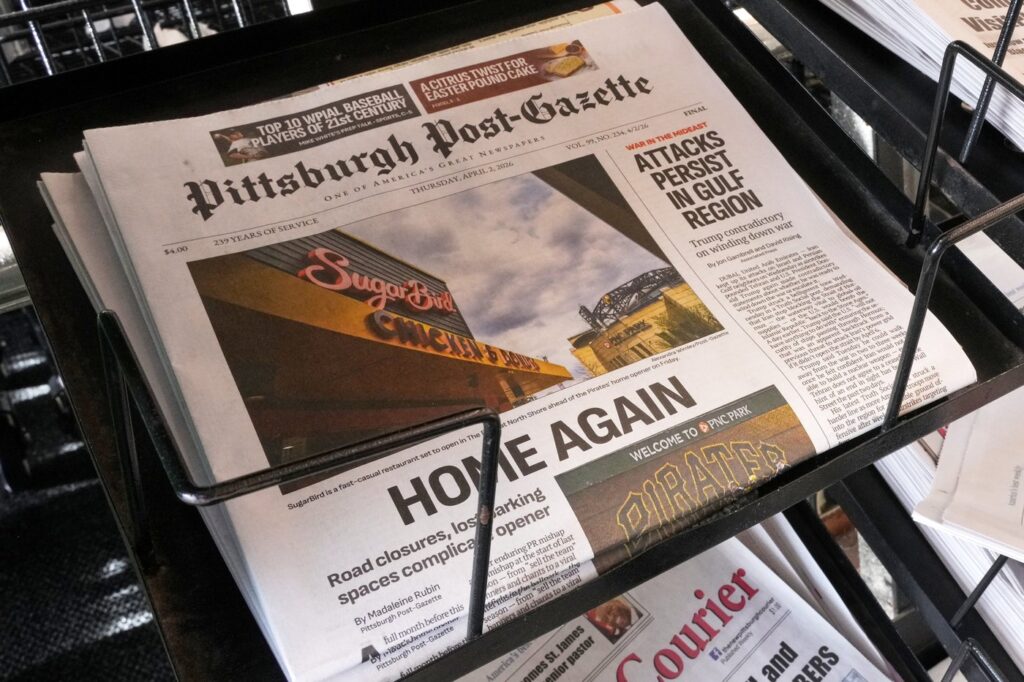
PITTSBURGH (AP) – In a remarkable turnaround within a few weeks this spring, Pittsburgh's media landscape has witnessed both a near-collapse and a revival. The owners of the Pittsburgh Post-Gazette recently announced its purchase by a nonprofit foundation, ensuring the historic newspaper's continuation. This decision came just as the Post-Gazette was on the brink of closure on May 3, which would have left Pittsburgh as the largest U.S. city without a locally-focused daily newspaper.
This spring's developments were particularly noteworthy amidst a trend of declining local news entities. The alternative outlet Pittsburgh City Paper experienced its closure announcement on New Year’s Day after operating for 34 years but quickly found new ownership and returned to the scene, aiming to cover community news, politics, and arts once again.
Difficult circumstances have marked the past two decades for local journalism in Pittsburgh, with many newsrooms closing or shrinking, and journalists losing their jobs. Halle Stockton, co-executive director and editor-in-chief of the digital news platform Public Source, pointed out that these crises forced the community to recognize the significance of local journalism. “It’s human nature that sometimes you have to be shaken a bit to realize what’s important in your life,” she commented.
The Pittsburgh Post-Gazette, originally founded on July 29, 1786, holds the distinction of being the first newspaper west of the Allegheny Mountains. Over the decades, it has undergone various name changes and structural reorganizations, ultimately consolidating under the name Post-Gazette in 1927. The newspaper gained notoriety for its Pulitzer Prize-winning coverage of the Tree of Life synagogue shooting in 2019.
In recent years, labor conflicts plagued the Post-Gazette, leading to a significant strike by its staff from 2022 to 2025, after which the publication struggled to maintain operations. The newspaper's eventual closure was announced coincidentally on the same day the U.S. Supreme Court rejected its ownership's appeal regarding a health benefits ruling favorable to former strikers.
The tumultuous state of the Post-Gazette laid the groundwork for its recent sale to the Venetoulis Institute for Local Journalism, a nonprofit organization that also manages The Baltimore Banner. Although Block Communications Inc. was not the highest bidder, community members were relieved it did not fall into the hands of a hedge fund known for depriving newspapers of resources. Andrew Conte, a journalism professor, noted that while the Blocks have long been criticized, they made efforts to assure the newspaper's future before exiting Pittsburgh.
As the Venetoulis Institute takes over, it marks the beginning of a significant rebuilding phase. With a commitment to invest $30 million over five years into both the Post-Gazette and The Baltimore Banner, stakeholders are hopeful. The Newspaper Guild of Pittsburgh expressed a desire to be included in the renovation process, although their future involvement remains uncertain.
Several other news outlets in Pittsburgh, anticipating the Post-Gazette’s potential demise, have already initiated plans to counter the gaps left by its absence. The Pittsburgh Tribune-Review, another local paper, is set to reinstate its Sunday print edition in Pittsburgh, a decade after ceasing operations in the city. Additionally, the Tribune-Review plans to add around a dozen new journalists to enhance its coverage across various sectors, aiming to compete despite being viewed by some as an outsider.
Public Source, launched in 2011 as an investigative outlet, is expanding its focus based on community feedback gathered from town hall meetings. Their promise to highlight local needs demonstrates an effort to engage the public in shaping local journalism.
As younger generations increasingly consume news through platforms like Instagram and TikTok rather than traditional newspapers, the challenge of engaging a new readership remains critical. A recent survey by the Pew Research Center revealed a decline in close following of local news, from 37% in 2016 to just 21% in 2025. This reality underscores the necessity for news organizations to collaborate rather than compete aggressively.
In summary, the unfolding media narrative in Pittsburgh reflects broader trends in the local journalism industry, merging the old with the new in an environment fraught with challenge. As various stakeholders strategize to revitalize and redefine local news, the future remains to be seen as they navigate an evolving landscape.








