

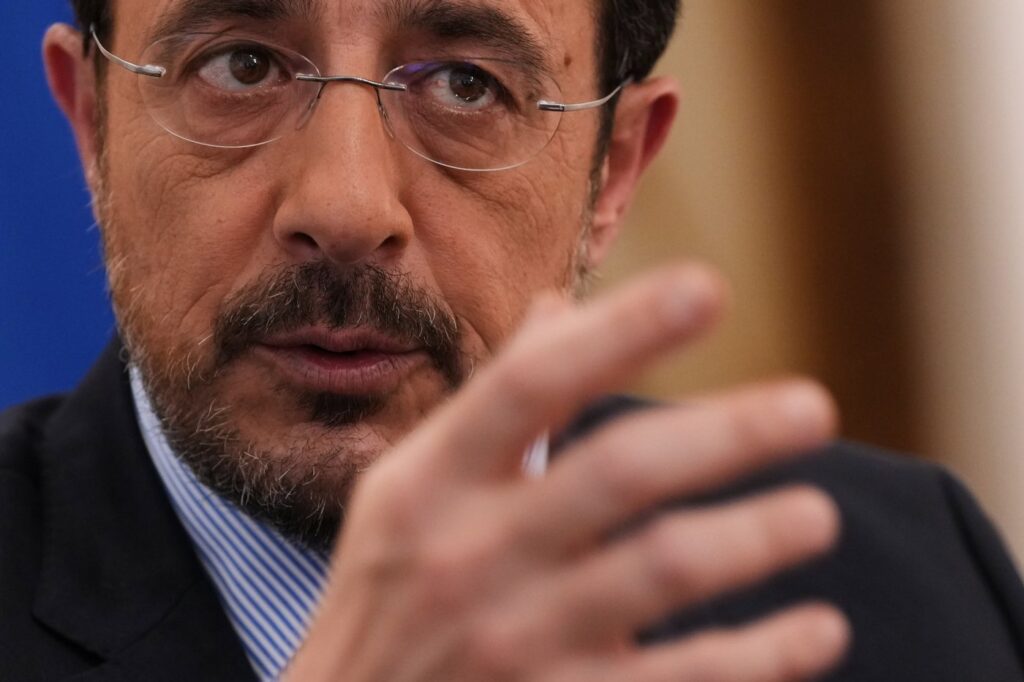
NICOSIA, Cyprus (AP) – In light of rising security concerns, the president of Cyprus, Nikos Christodoulides, has urged European Union (EU) leaders to begin drafting a playbook for responding to calls for assistance from member states under attack. This initiative, discussed in a recent interview, aims to give substance to Article 42.7 of the EU treaties, which mandates support among member states during crises.
Article 42.7 states that if a country experiences armed aggression, other member states must provide "aid and assistance by all the means in their power." The article has never been activated before, resulting in a lack of specific protocols regarding how EU countries should respond to such situations. Christodoulides emphasized the need for a comprehensive operational plan during an EU-Mideast summit, where topics including the ongoing Iran conflict will be addressed.
The issue of mutual defense resonates particularly with Christodoulides following a recent incident where a Shahed drone struck a British air base on Cyprus's southern coast. The drone, reportedly launched from Lebanon, prompted several EU countries — including Greece, France, Spain, The Netherlands, and Portugal — to send ships equipped with anti-drone capabilities to help safeguard Cyprus.
Christodoulides pointed out the added complexity that arises due to many EU nations also being NATO members. He expressed the need for clarification on how these countries would respond to calls for help, avoiding any potential conflicts with their NATO commitments. Under NATO's Article 5, an attack on one member is seen as an attack on all, presenting a nuanced challenge for EU and NATO interplay in crisis scenarios.
Another important topic involves whether responses under Article 42.7 would follow a collective NATO model or be limited to neighboring countries. Christodoulides highlighted different factors that need to be considered to effectively respond to diverse crises that might arise.
During the interview, Christodoulides also expressed satisfaction with the EU's growing recognition of the importance of strengthening ties with the Middle East. Initiatives such as the Mediterranean Pact aim to implement specific projects addressing health, education, and energy in Middle Eastern countries. The upcoming informal EU leaders' summit will see participation from leaders of Egypt, Lebanon, Syria, and Jordan, which presents a valuable opportunity to foster cooperation at a strategic level.
Christodoulides underscored Cyprus's role as a representative for Greater Middle Eastern countries within the EU, noting the trust that regional nations place in Cyprus to advocate for their interests in Brussels.
Additionally, the Cypriot president is a strong advocate for the India-Middle East-Europe Economic Corridor (IMEC), which aims to create trade, energy, and digital connectivity between the region and India. Under the Cypriot EU presidency, a "Friends of IMEC" group has been established to promote this initiative, though specific projects are still in development, with the Great Seas Interconnector being one priority project that aims to unite the electricity grids of Greece, Cyprus, and eventually Israel.
The ongoing conflict in Iran has accelerated discussions about the need for the EU to diversify its energy sources. Christodoulides noted that he is in discussions with the EU’s executive arm to explore how Cyprus's offshore natural gas deposits could potentially aid in this effort, as the bloc seeks to reduce its reliance on traditional energy sources.
Moreover, Christodoulides called attention to an imminent announcement by European Commission President Ursula von der Leyen, slated for Friday, which promises specific proposals on energy costs and strategies to enhance the bloc's energy independence.
Reflecting on recent years, Christodoulides remarked that while the EU has made strides in expediting decision-making, it has fallen behind on its commitments regarding the accession of new members, which has led to a loss of trust among prospective member nations. He underscored the importance of addressing enlargement as a critical geopolitical tool for the EU.








