

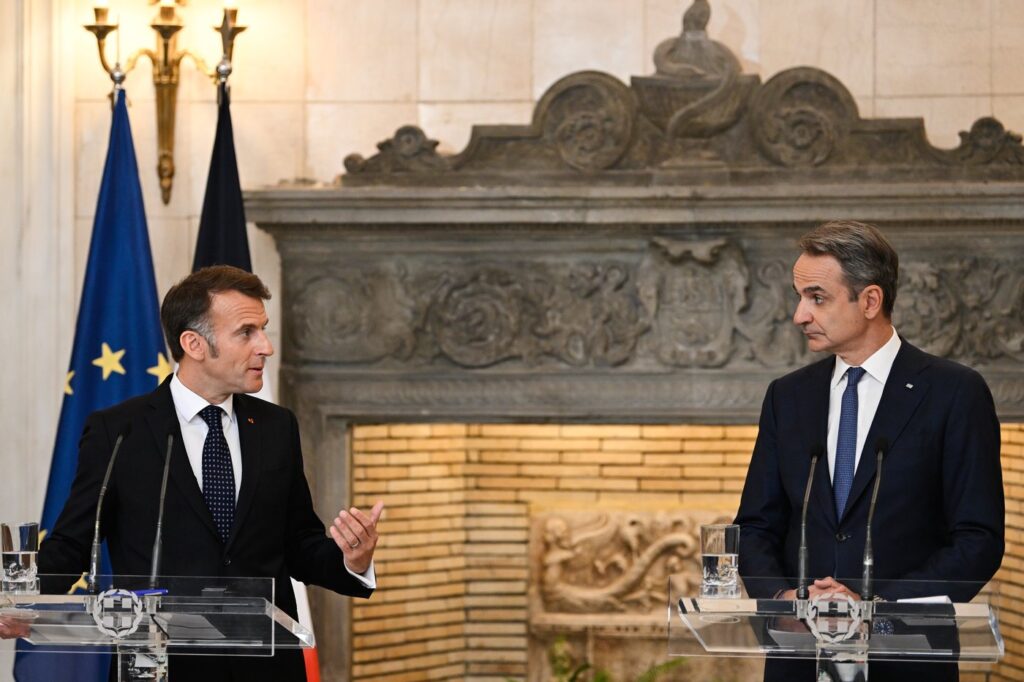
ATHENS, Greece — The European Union's current initiative to enhance its defense capabilities is not meant to create an alternative to the North Atlantic Treaty Organization (NATO), but rather to respond to a long-standing call from the United States for Europe to take greater responsibility for its own security, French President Emmanuel Macron stated on Saturday.
During discussions with Greek Prime Minister Kyriakos Mitsotakis, Macron emphasized the importance of not undermining NATO, which plays a crucial role in linking Europe with its American ally. Instead, he pointed out that European nations are finally committing to meet the U.S. demand made over the past decade for increased self-reliance in security matters. "The lesson we must draw is, let us no longer be dependent," Macron stated, underlining the necessity of strengthening the European pillar of NATO and enhancing a defense strategy that is not aimed against anyone or as an alternative to existing alliances.
Prime Minister Mitsotakis echoed Macron's sentiments, suggesting that the U.S. should appreciate the EU's commitment to self-reliance in defense and its increased investment in this sector, describing Washington's demand for higher spending as "justified." Following a European Union leaders’ summit in Cyprus, Macron's visit to Athens also served to renew a defense partnership established in 2021 between France and Greece, which includes a mutual assistance clause for armed attacks against either nation. "This mutual assurance and assistance clause is inviolable, and it is not up for debate between us," Macron asserted, indicating a unified front against potential threats to either country.
The renewed 3-billion-euro defense agreement entails the acquisition of 24 Rafale fighter jets and four advanced frigates, including the Kimon, which Macron and Mitsotakis toured together. Greece, which has historically had contentious relations with Turkey, is modernizing its military capabilities, and a significant portion of its defense procurement has occurred through contracts with France. This includes the French MICA anti-air missile system, applicable to aircraft, land forces, and naval vessels.
Both leaders view this agreement as a model for other EU nations to emulate in order to enhance the competitiveness of the 27-member bloc. Mitsotakis urged EU leaders to move past "national egotism" that erects barriers around domestic industries, advocating for more mergers within the defense sector to leverage economies of scale. Macron also emphasized the need for European industry to foster innovation and reclaim consumer trust through superior products that can finance the EU's defense ambitions. "All of us Europeans need to buy more European products, produce more European goods, and innovate more within Europe," he stated.
The French President referred to Article 42.7 of the EU mutual defense clause, asserting that it is not merely rhetorical. He highlighted the prompt response of both nations in dispatching warships to support fellow EU member Cyprus in response to a drone strike that occurred earlier in March. Macron cautioned against spreading panic regarding potential fuel shortages resulting from the closure of the Strait of Hormuz, through which about 20% of the world’s oil and gas passes. He reassured that fuel supply remains "under control," expressing confidence that no shortages are anticipated and acknowledging that it may take time to normalize the situation in the region.
Mitsotakis, in light of Greece's status as a global shipping hub, emphasized that any diplomatic resolution should include a "non-negotiable" clause ensuring complete freedom of navigation through the strait, free from tolls on ships—conditions that were prevalent before the onset of the conflict involving Iran.








