

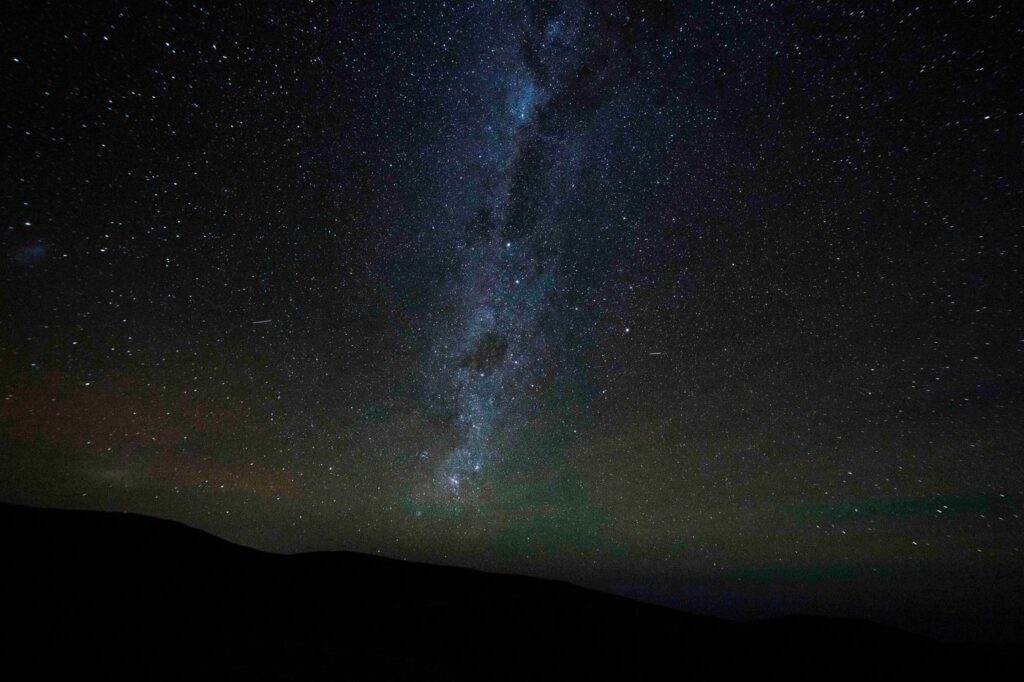
In the Atacama Desert of Chile, the night sky presents a breathtaking spectacle filled with stars, planets, and entire galaxies, making it one of the clearest windows to the universe. Known as the driest place on Earth, this unique location benefits from a rare combination of a dry climate, high altitude, and isolation from urban light pollution. These conditions have established the Atacama as a vital center for world-class astronomical research and home to the largest ground-based astronomical projects globally.
Chiara Mazzucchelli, president of the Chilean Astronomical Society, highlighted the exceptional nature of the region, stating that it boasts over 300 clear nights per year, free from clouds and rain. However, the extraordinariness of the Atacama's dark skies is currently under significant threat. In 2022, plans for a green energy project located just kilometers away from the Paranal Observatory—a key facility managed by the European Southern Observatory (ESO)—sparked a fierce debate between scientists and the energy firm proposing the construction.
The proposed energy development raised concerns among astronomers about potential impacts on astronomical work, such as increased light pollution, micro-vibrations, dust, and atmospheric turbulence, which would render astronomical observations nearly impossible. Following widespread backlash from the scientific community, which included physicists and Nobel laureates, the project was ultimately canceled in January 2023. However, the situation revealed that existing regulations designed to protect the night sky were insufficient, outdated, and lacking clarity.
In response to these concerns, Daniela González, director of the Cielos de Chile Foundation, emphasized the need for stricter criteria to safeguard astronomical zones. The Atacama Desert, particularly its Photon Valley, is home to nearly 30 astronomical sites, many operated by international organizations such as ESO. The region attracts thousands of astronomers each year, drawn by the opportunity to participate in cutting-edge research, like that at the Paranal Observatory, which is known for some of the most advanced telescopes in the world.
The construction of the Extremely Large Telescope (ELT), anticipated to be completed by 2030 at a cost of $1.5 billion, exemplifies the ambitious projects enabled by the Atacama’s conditions. With its 798 mirrors and an impressive light-gathering area, the ELT will surpass current telescopes in both power and clarity, allowing astronomers to observe Earth-like planets within potentially habitable zones.
Despite the region's historical status as an “ocean of darkness,” Eduardo Unda-Sanzana, director of the Astronomy Center at the University of Antofagasta, pointed out that rapid urbanization, industrialization, and the rise of mining and wind farms have drastically altered the Atacama landscape. At the Paranal facility, precautions are taken to minimize human presence and light interference; staff members reside in underground accommodations where windows are covered, hallways are dark, and movement is restricted to flashlight use to protect sensitive astronomical equipment.
Before the cancellation of the green energy project, the scientific community had sounded the alarm over its potential negative impacts on light pollution and other environmental factors critical to astronomy. Unda-Sanzana warned that without rigorous, updated regulations, similar projects could emerge, jeopardizing the Atacama's invaluable night sky further. Referring to historical precedents, he recalled the closure of the first international heliophysics observatory in Chile in 1955 due to environmental degradation caused by mining activities, stressing the importance of learning from previous mistakes and preserving this extraordinary scientific sanctuary for future exploration.








