

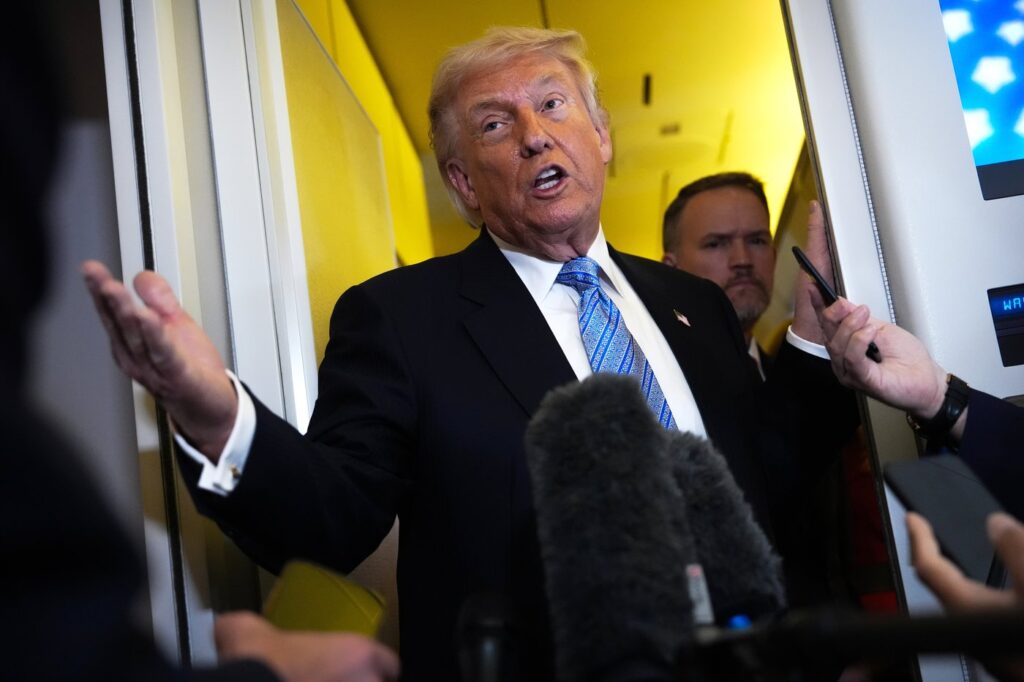
BEIJING — During a three-day visit to China, President Donald Trump took an unusually restrained approach, mostly avoiding the media and social media while engaged in serious discussions with Chinese President Xi Jinping. The focal point of these discussions revolved around Taiwan, as well as the broader complexities of U.S.-China relations, raising concerns over potential conflict over the self-governing island.
The meeting began with Xi cautioning Trump against mishandling relations regarding Taiwan, indicating that it could lead to a clash or even open conflict between the U.S. and China. Notably, Trump chose not to publicly address Taiwan during his visit. However, upon returning aboard Air Force One, he hinted that Xi’s firm stance on the matter might cause him to reconsider a planned arms sale to Taipei. The longstanding diplomatic tensions over Taiwan were notably evident, with Trump previously having authorized significant arms deals, including an $11 billion package in December and a $14 billion sale approved in January, which remain unfulfilled.
Despite the discussions in China, Trump's comments remained measured. When asked about intervening militarily if China attacks Taiwan, Trump opted for a vague response that aligned with the U.S. policy of strategic ambiguity. This policy allows Washington to support Taiwan's defense while deliberately leaving unclear the extent of military involvement in case of an aggression, reflecting a cautious U.S. stance in the region.
Trade discussions also featured prominently during the trip. Trump arrived with a delegation of high-profile CEOs, including Boeing's chief and Elon Musk of SpaceX, suggesting that substantial commercial agreements were on the horizon. However, despite these optimistic assertions, Trump departed without announcing concrete deals, with speculation about potential orders for 200 to 750 Boeing planes lingering without confirmation.
While Trump expressed optimism about future negotiations, he showered praise on Xi throughout the visit, calling him a “great leader” and emphasizing the potential for a “fantastic future together.” In contrast, Xi offered more measured responses, focusing on establishing a “constructive and stable” framework for bilateral relations moving forward.
The leaders also delved into global issues, including the ongoing conflict in Iran, where Trump claimed that Xi shared his concerns about a nuclear-armed Iran and expressed support for U.S. efforts to stabilize the Strait of Hormuz. Xi's reported willingness to engage more with the situation in Iran could indicate a potential shift in China’s involvement in international affairs.
As the visit concluded, the Chinese Foreign Ministry announced that both leaders had agreed on a new framework for a relationship based on strategic stability, aiming to manage bilateral differences while fostering cooperation. Some experts viewed this as a positive development, marking a shift from the previous competition-oriented narrative prevalent during the Biden administration.
In summary, Trump’s visit highlighted the delicate balance of managing U.S.-China relations, especially regarding Taiwan and global trade dynamics. By juggling praise for Xi while grappling with crucial diplomatic issues, Trump navigated a complex bilateral landscape, leaving many questions about the future trajectory of U.S.-China interactions unanswered.








