

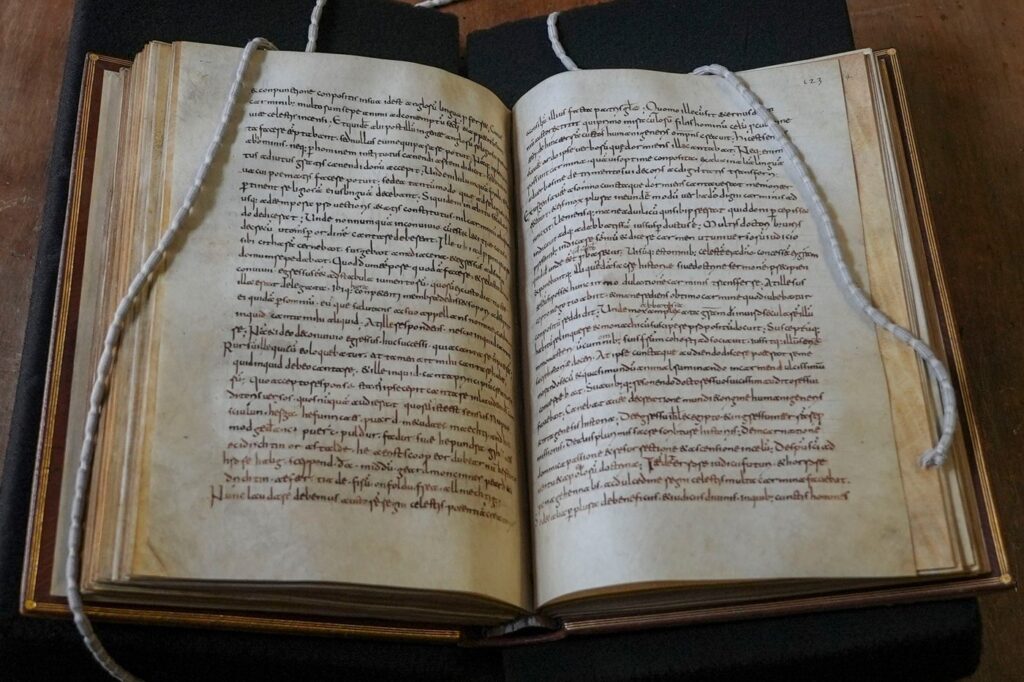
ROME (AP) – Researchers from Ireland made a remarkable discovery while examining a digitized medieval book housed in a Roman library. They stumbled upon what they believe to be the oldest surviving English poem: "Caedmon’s Hymn." This poem, composed in Old English by a Northumbrian agricultural worker in the 7th century, can be found within some copies of the "Ecclesiastical History of the English People," a Latin work penned by the Venerable Bede, a monk who is also considered a saint. Elisabetta Magnanti, a visiting research fellow at Trinity College Dublin’s School of English, expressed her immense surprise at the find, emphasizing the poem's unique presence embedded within the main body of Latin text.
"Caedmon’s Hymn" is regarded as a seminal piece in the history of English literature, with Mark Faulkner, an associate professor of medieval literature at Trinity, asserting that the manuscript they uncovered is one of the oldest, dating back to the 9th century. Prior to this discovery, the earliest known copy of the poem dated from the early 12th century. The proximity of this new find to the 7th century suggests a notable early diffusion of the English language, contradicting previous understandings of its linguistic development.
The history of the manuscript is as complicated as it is intriguing. According to Faulkner, Caedmon was inspired to write his poem while working at Whitby Abbey in North Yorkshire. After feeling inadequate for not having a suitable poem to recite during a feast, he retreated to bed, where he dreamt of a divine figure prompting him to sing about creation. This led to the creation of the nine-line hymn that has now resurfaced 1,400 years later in Rome’s main public library.
The manuscript’s journey involved crossing the Atlantic at least twice and changing ownership multiple times. Originally transcribed in the Benedictine abbey of Nonantola, near modern-day Modena in northern Italy, it was integral to manuscript reproduction during the Middle Ages. In the 17th century, following the decline of the abbey’s prominence, the manuscript was relocated to various locations, including the Vatican and then a small church. Throughout its history, many parts of the collection went missing, only to resurface in prestigious collections during the 19th century.
The manuscript fell into the hands of renowned English antiquarian Thomas Phillipps, who, after encountering financial difficulties, sold segments of his notable collection. The manuscript ultimately passed into the possession of Swiss bibliophile Martin Bodmer, and later found its way to a rare bookseller, H.P. Kraus, in New York City during the 20th century. Italy's culture ministry, in a bid to reclaim the missing manuscripts from Nonantola Abbey, acquired the copy of Bede’s history from Kraus in 1972, where it has since remained largely unnoticed.
Magnanti, who dedicated over four years researching Bede’s history and cataloging existing copies, discovered this hidden gem. She had intended to investigate the library catalog when she inquired about the book. After reaching out, library officials confirmed its presence, and she received digital images of the manuscript three months later.
The poem itself resonates with themes of creation and divine majesty, emphasizing the might of the creator and the foundations of the earth laid out for mankind. The first stanza encapsulates a praise for the "guardian of the heavenly kingdom," reflecting the spiritual and cultural significance of the text.
In line with contemporary trends towards accessibility, Rome’s National Central Library is digitizing its entire Nonantolan collection, making it freely available online. This initiative is a part of the library's broader project to digitize thousands of rare books and manuscripts, further enabling scholars and researchers around the world to access these historical treasures.
Andrea Cappa, head of the library’s manuscripts and rare books reading room, noted that the discovery by Trinity College experts represents just the beginning of a series of potential finds across various fields, highlighting the value of international cooperation in historical research.








