

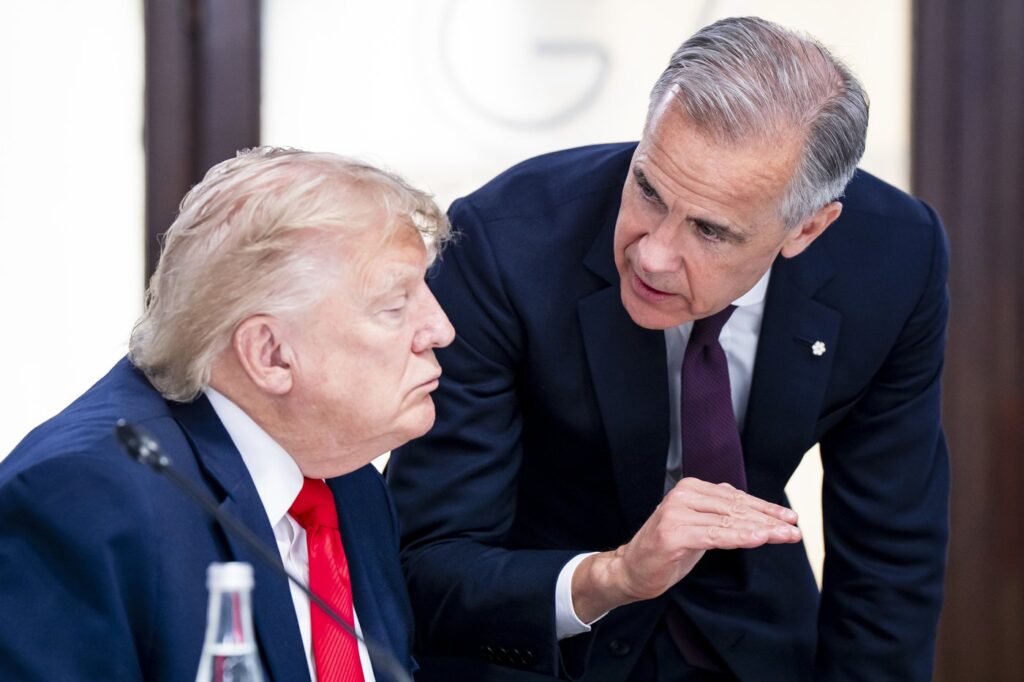
U.S. President Donald Trump has announced the implementation of a new tariff threat targeting $28 billion worth of Canadian goods, which is set to take effect just after midnight on August 19, 2019. This move comes in the wake of escalating trade tensions between the United States and Canada.
A spokesperson from the Prime Minister's Office revealed that Prime Minister Mark Carney had a phone conversation with Trump on the afternoon prior to the tariffs' announcement. However, no specific details regarding the discussion were shared. During an event in St. John's, Newfoundland, Carney communicated in French, assuring that the federal government has a plan that "will cover all eventualities" if the tariffs are indeed imposed. He emphasized that negotiations are "very intense and delicate."
Last month, under an executive order signed by Trump, tariffs of 50 percent were approved for a wide array of goods, ranging from cement to hockey sticks. These items collectively represent about five percent of Canada's exports to the U.S. Trump's rationale for this tariff escalation is rooted in section 338 of the Tariff Act of 1930, which permits a president to levy tariffs on countries perceived as discriminating against U.S. products.
As the clock ticked down to the effective time of the tariffs, Canada-U.S. Trade Minister Dominic LeBlanc and chief trade negotiator Janice Charette were engaged in discussions in Washington, D.C., having been there since the previous week. On Monday, they met with U.S. Trade Representative Jamieson Greer and Commerce Secretary Howard Lutnick. When approached by reporters while leaving the meeting, LeBlanc stated, "our job is not done yet."
The U.S. justifications for the latest tariffs revolve around several contentious issues, including provincial bans on American alcohol, limited access for U.S. dairy products resulting from Canada's supply management system, and Canadian quotas on tariff-free American auto imports. These auto quotas and alcohol restrictions have been instituted by Canada as a counter-response to existing U.S. tariffs on steel, aluminum, and automobiles.
In his remarks, Greer commented that Canadian retaliatory measures are reminiscent of actions typically taken by China. Several Canadian provincial leaders have voiced their refusal to restore American alcohol sales within their jurisdictions. Ontario Premier Doug Ford suggested a willingness to reconsider such bans if it would pave the way for a "fair deal" regarding sectors adversely affected by Trump's existing tariffs.
Canada's efforts are currently focused on seeking relief from the U.S. tariffs affecting metals, automobiles, and softwood lumber. The U.S. contends that these sectors receive unfair government subsidies. Arnold Viersen, the Conservative natural resources critic with an emphasis on forestry, commented on the distress caused by tariffs and mill closures in lumber-reliant communities. For instance, Vancouver-based Canfor announced the permanent shutdown of its Fox Creek sawmill in northwestern Alberta, attributing the decision to U.S. tariffs alongside weak market conditions impeding the mill's productivity and competitiveness.
Viersen highlighted the impact of this closure on a town with a population of fewer than 1,800 people, stating it would eliminate 74 well-paying jobs, leaving many workers and families in financial peril. He urged the government to uphold its commitment and negotiate a favorable agreement with the U.S. for the benefit of Canadian workers.
His sentiments were echoed by Bea Bruske, president of the Canadian Labour Congress, who stressed the importance of remaining firm during negotiations. Bruske stated that Canadian workers require a deal that would protect quality jobs, bolster the economy, and ensure stability for communities. She emphasized that Canada must be prepared to assert its interests firmly and have a strategic plan to support workers and communities should the tariffs be enacted.
Additionally, the tariffs would significantly impact the Canadian honey industry, as approximately 60 percent of domestic honey exports are directed to the United States. The Canadian Beekeepers Federation expressed concerns that such tariffs could lead to devastating consequences, potentially causing plummeting prices that could drive farms into bankruptcy.








