

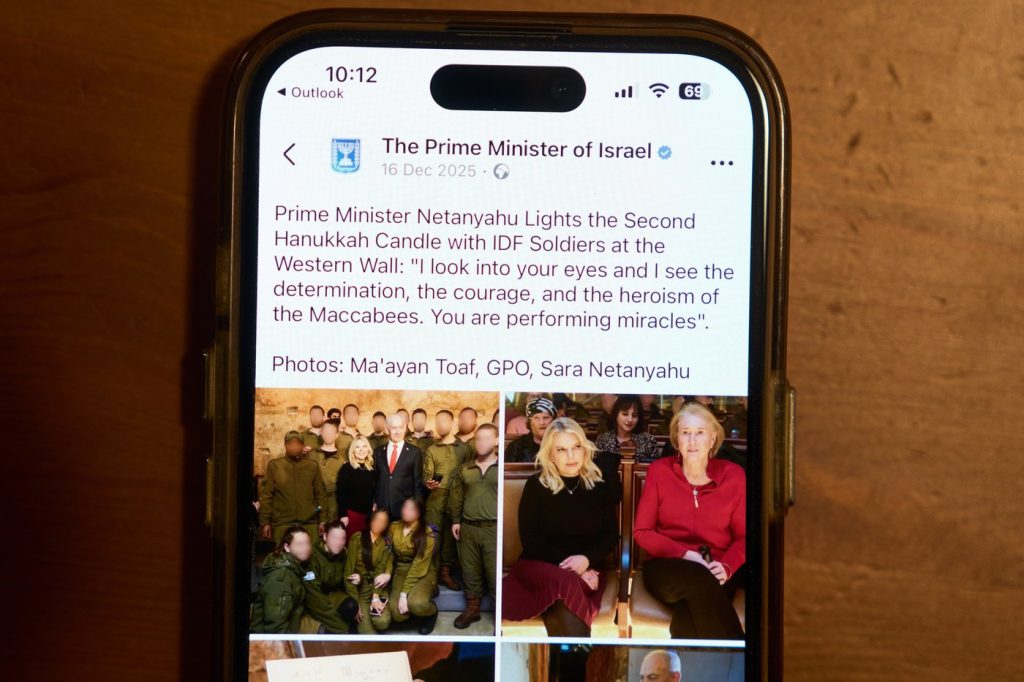
JERUSALEM (AP) – Recent images of Israeli Prime Minister Benjamin Netanyahu and his wife, Sara, lighting Hannukah candles at the Western Wall have sparked controversy due to heavy photo-editing. In these official pictures, Sara Netanyahu's appearance is unnaturally flawless, raising concerns among critics who argue that such manipulations distort reality and undermine ethical standards in government communications.
Shabi Gatenio, a veteran political journalist, highlighted the implications of using retouched images in official documents. He expressed that historically, Israel's state archives contain authentic photographs that accurately reflect reality, contrasting sharply with the digitally altered images now being circulated. Gatenio emphasized the potential long-term impact on archival integrity, warning that this could lead to a skewed historical record.
In light of the backlash, the Israeli government has begun crediting Sara Netanyahu in releases that include manipulated images, an unprecedented move aimed at increasing transparency. Nitzan Chen, director of the Government Press Office, clarified that images of the Prime Minister himself are never edited, asserting that the office will refrain from including retouched photos in the official archive.
Sara Netanyahu, 67, has a history of utilizing photo-editing software, often showcasing heavily modified images on her social media platforms. The concern began garnering attention last summer during her visit to the U.S., where several official images appeared to be edited, including those taken during public appearances alongside high-profile figures like former President Donald Trump.
Hany Farid, a digital forensics expert from the University of California, Berkeley, pointed out that certain images displayed signs of smoothing and beautification that deviate from the original recordings. While Farid noted that the adjustments may not be outright malicious, he raised crucial questions about the trustworthiness of official photos in the political sphere.
As investigations continue to determine how to handle retouched images, Chen indicated a commitment to ensuring proper identification of processed photos. The Justice Ministry is also examining guidelines regarding image manipulation, but Chen reassured that there aren’t any legal concerns surrounding photo edits, stressing the importance of transparency with any alterations made.
Reports show that at least one outlet, the Times of Israel, has decided to stop publishing state photos suspected of manipulation, while the Associated Press has similar policies against retouched images.
Interestingly, while Chen claims that the Prime Minister's images are untouched, Netanyahu's official Instagram account contradicts this assertion, featuring content that appears AI-edited or generated. An instance is a shared image celebrating the New Year with the Trumps, where discrepancies in Sara Netanyahu’s attire and other details raised eyebrows among observers. The photo has since been marked with an indication of potential alterations.
Critics argue that the trend of using AI and photo-editing tools in political communication aligns with global practices among leaders like Trump, reflecting a broader shift towards curated public personas. Tehilla Shwartz Altshuler, a political analyst, described this approach as representative of a populist strategy, facilitating a controlled narrative that emphasizes idealized images of political figures.
The ongoing debate over the manipulation of official images highlights a critical issue in governmental accountability and historical preservation. As modern technology evolves, the challenges surrounding truth in representation and official record-keeping become increasingly significant, with profound implications for the integrity of state communications.








