

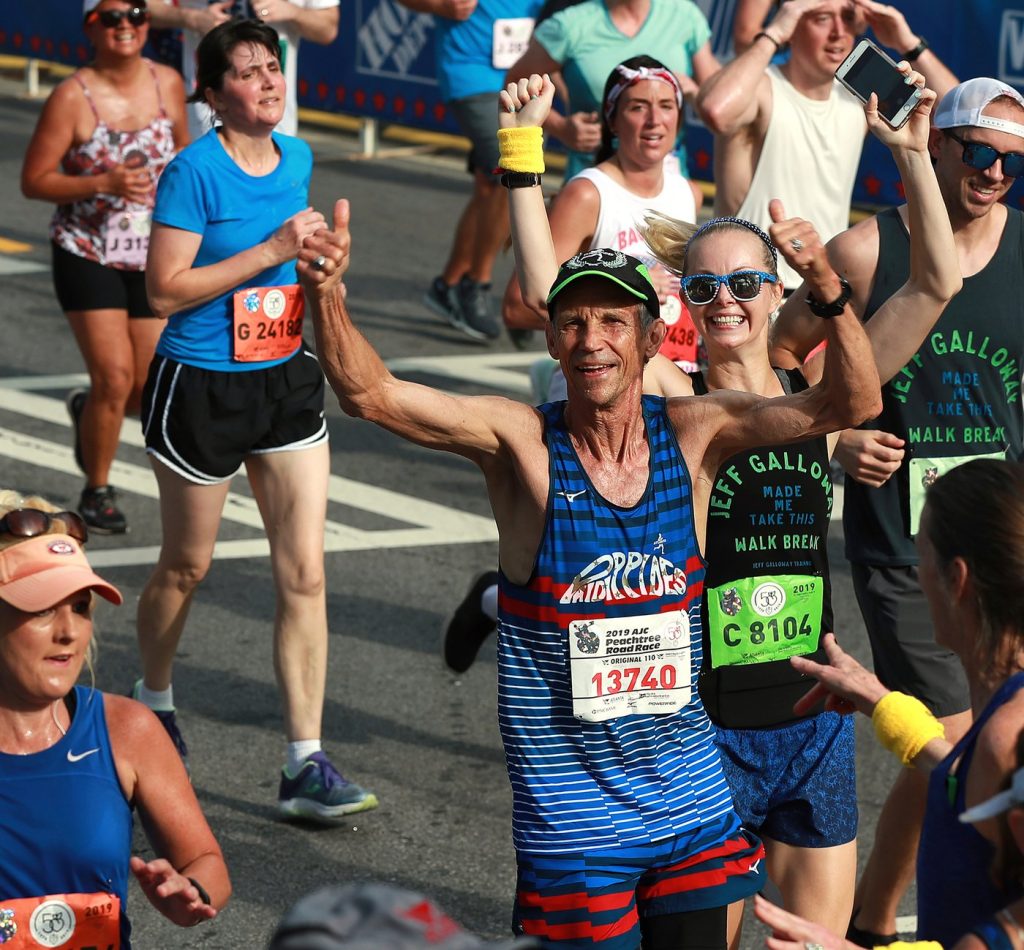
Jeff Galloway, a prominent figure in the running community and member of the 1972 U.S. Olympic team, passed away on Wednesday at the age of 80. He was widely known for his innovative run-walk-run strategy, which inspired elite athletes as well as everyday runners, making races more accessible to a broader audience.
Galloway died due to a hemorrhagic stroke while being treated at a hospital in Pensacola, Florida, as reported by his daughter-in-law, Carissa Galloway. In his final days, the outpouring of support from the running community was evident as many expressed their gratitude for his motivational guidance through videos shared online, especially in light of his recent emergency neurosurgery.
The announcement of Galloway's surgery was made by his family on February 20, inviting the public to share messages of support. Jim Vance, an elite endurance consultant from San Diego, referred to Galloway as a "pioneer" in the sport of running, emphasizing how he broke down mental barriers that often discourage newcomers. Vance noted that running should be enjoyable rather than a "suffer-fest," a philosophy that Galloway lived by.
A remarkable athlete, Galloway had overcome heart failure in 2021 and was looking forward to completing another marathon, having participated in over 230 during his lifetime. He stated in December, “My mission now, at the age of 80-plus, is to show that people can do things that are normally not done, and can do them safely.”
Galloway invented the run-walk-run method in 1974 when he led a running class at Florida State University, just two years after competing in the 10,000 meters at the Olympic Games. He sought to attract customers to his new running specialty store, Phidippides, which aimed to introduce running to individuals who had not been active for several years. Galloway noted that he began with walking and interspersed short jogs, ensuring that participants would finish either a 5K or a 10K with smiles on their faces.
He firmly believed that incorporating walking during runs could reduce the risk of injuries and save energy. Galloway consistently fine-tuned the ratios of running to walking to accommodate individual paces and needs. In a notable achievement, he completed the 1980 Houston Marathon faster than any of his previous race times by utilizing his run-walk approach, finishing with a time of 2:16:35.
Galloway was dedicated to sharing his philosophies on running through various books, websites, and retreats. He served as the official training consultant for runDisney, a series of races hosted at Walt Disney Co. resorts, where he also participated as a runner. Following his recent surgery, many fans and admirers took to social media to pay tribute to him, emphasizing the profound impact he had on their lives.
Participants in Galloway’s programs often shared their transformative experiences. For instance, Karen Bock-Losee from Jacksonville, Florida, reflected on how she never thought she would run a half marathon until she discovered Galloway's methods at the age of 70. In 2011, Susan Williams recounted a moment during a half marathon when Galloway turned back to encourage her as she struggled towards the finish line. Such stories reflect the accessibility and encouragement Galloway offered to runners of all levels.
Bobby McGee, a Colorado-based running coach, echoed this sentiment by noting that Galloway's method made running appealing to the masses. He remarked that after any run, participants discuss their time without questioning whether they ran the entire distance. Galloway is survived by two sons and six grandchildren, leaving behind a lasting legacy that will continue to inspire future generations of runners.








