

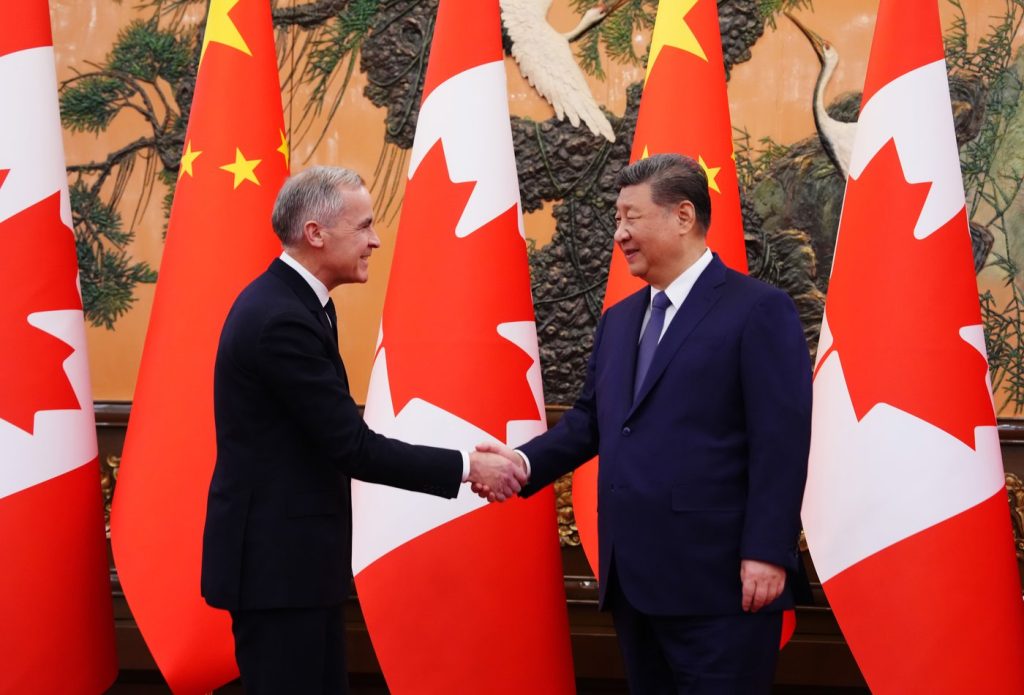
OTTAWA - Prime Minister Mark Carney emphasized the potential benefits of a recently signed electric vehicle (EV) deal with China, describing it as a significant "opportunity" for Ontario and its autoworkers. This statement comes despite opposition from Ontario's Premier Doug Ford and the union representing Canadian autoworkers, who have raised concerns about the implications of the agreement.
While speaking at a news conference in Doha, Carney highlighted the interest from Chinese companies to produce "affordable" electric vehicles in Canada. He noted that there have been direct conversations with these companies, indicating a clear desire to partner with Canadian firms. "We’ll see what comes to pass," Carney stated, firmly positioning the deal as a promising opportunity for Ontario workers and the Canadian economy, albeit with a cautious approach and a modest beginning.
The agreement, signed by Carney and Chinese President Xi Jinping on January 16, 2026, permits the import of Chinese electric vehicles into Canada at a 6.1 percent tariff rate. It sets an annual import quota of up to 49,000 Chinese EVs, with the stipulation that at least 50 percent must have an import price of under $35,000 by the year 2030. This deal comes in the wake of Canada and the United States imposing a 100 percent tariff on Chinese EVs starting in 2024 due to allegations of unfair subsidies and market dumping.
Premier Doug Ford expressed strong reservations about the deal in a social media statement, arguing that it poses a risk of oversaturating the market with low-cost Chinese electric vehicles without ensuring Canadian investment. He warned that lowering tariffs could close opportunities for Canadian automakers to access the American market, which is crucial for exports, potentially resulting in economic setbacks and job losses.
Lana Payne, president of Unifor, condemned the deal, referring to it as a "self-inflicted wound" on an already struggling Canadian auto industry. She cited examples from the U.K. and Brazil, suggesting that once Chinese companies enter a market, they quickly gain significant market share, potentially harming local manufacturers.
In response to concerns, Carney characterized the deal as a trial phase for entering the market, reiterating Canada's commitment to being competitive in the future auto market. "We don’t want to be competitive in the market of 2000, 2010. We want to compete in the future," he asserted, indicating that this approach is essential for creating quality jobs for Ontarians in the coming years.
The Prime Minister underscored that any production by Chinese automotive firms in Canada must comply with the country's labor standards, signaling a commitment to protect Canadian workers' rights as part of the deal. In conjunction with tariff reductions on automobiles, China has promised to significantly cut tariffs on Canadian canola seed from 84 percent to 15 percent beginning March 1, 2026, and to eliminate tariffs on canola meal, lobster, peas, and crabs for at least the rest of the year. However, no changes have been made regarding the 100 percent tariff on canola oil or the 25 percent tariff on Canadian pork, which remain points of contention.
The effects of American tariffs on Canadian automotive exports have been a pressing issue, particularly amidst statements from former U.S. President Donald Trump, who asserted that the U.S. does not need cars manufactured in Canada. Despite previous tensions, Trump praised Carney's efforts in securing a trade deal with China, acknowledging the importance of such agreements in his comments.
This report sheds light on ongoing negotiations and disputes regarding the future of Canada's automotive sector, highlighting the delicate balance between fostering international trade and safeguarding domestic industries.








