

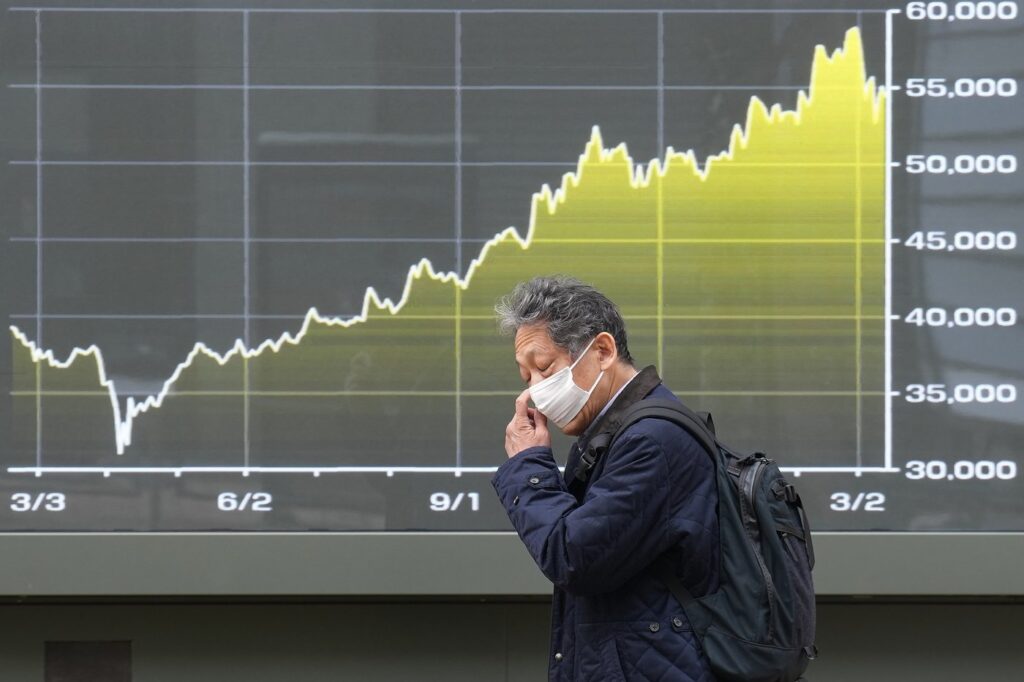
HONG KONG (AP) – Asia's stock markets mostly dipped on Friday, following the downward trend set by Wall Street losses. As concerns over the ongoing Iran war continued to escalate, oil prices remained around the $100 per barrel mark, raising significant worries about crude oil and gas supplies.
The Tokyo Nikkei 225 index saw a decline of 1.1%, closing at 53,857.89, with technology-related stocks facing notable losses, including a 4.3% drop for SoftBank Group. South Korea's Kospi fell by 1.3% to 5,509.22, while Hong Kong's Hang Seng index decreased by 0.5%, finishing at 25,594.25. The Shanghai Composite index edged down 0.2% to 4,120.14. Meanwhile, Australia's S&P/ASX 200 recorded a slight increase of 0.1%, reaching 8,636.90, whereas Taiwan's Taiex traded 0.3% lower.
In the United States, futures showed a modest gain of 0.4%. Oil prices remained stable, with Brent crude—recognized as the international benchmark—hovering near $100 per barrel after peaking at this level on Thursday. Earlier in the week, Brent crude had surged to nearly $120, the highest prices observed since 2022. Conversely, benchmark U.S. crude saw a reduction of 0.2%, landing at $95.55 per barrel.
The eyes of the market have been firmly on Iran, where the new Supreme Leader, Ayatollah Mojtaba Khamenei, made his first public statements, asserting that Iran would persist in fighting and utilize the Strait of Hormuz as leverage against the United States and Israel. This strait is critical for oil and gas transport, accounting for approximately 20% of the world's oil transport. Analysts have noted that disruptions in marine traffic due to the ongoing tensions have already raised alarms regarding potential supply disruptions.
Khamenei's comments came on the heels of U.S. President Donald Trump's assessment of the situation, describing the war as “very complete.” This has intensified investor anxieties about the duration and implications of the conflict. As oil prices have experienced significant volatility since the onset of the Iran war, with Brent crude spiking to its highest levels this week, the International Energy Agency announced that its member countries would release a record of 400 million barrels of oil from their emergency reserves. However, many economists believe that this measure may not suffice to reassure the markets.
The escalation in oil prices is expected to exacerbate global inflation, impacting consumers negatively. Rising fuel costs are already affecting consumers worldwide. Additionally, increases in energy prices may contribute to heightened production costs related to artificial intelligence and chip manufacturing, according to market analysts.
In the U.S., stock markets faced declines on Thursday amidst a month characterized by volatility. Specifically, the S&P 500 fell by 1.5% to close at 6,672.62, the Dow Jones Industrial Average decreased by 1.6% to 46,677.85, and the Nasdaq composite saw a 1.8% drop, finishing at 22,311.98. Companies heavily reliant on fuel, such as Carnival Cruises and United Airlines, experienced significant losses, with shares falling by 7.9% and 4.6%, respectively.
Other trading activities on Friday saw declines in gold and silver prices, with gold down by 0.1% to $5,119.50 an ounce, and silver dropping 0.3% to $84.85 per ounce. The U.S. dollar strengthened, exchanging at 159.40 Japanese yen up from 159.34 yen. The euro also experienced a slight depreciation against the dollar, trading at $1.1507, down from $1.1512.








