

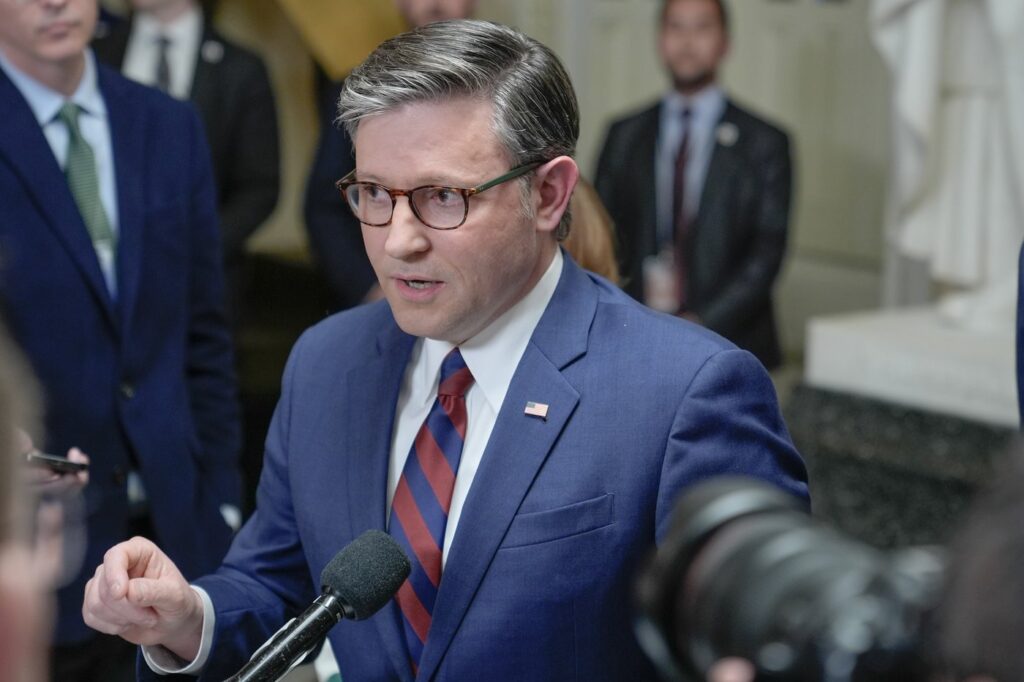
WASHINGTON (AP) — The Senate aims to swiftly pass a funding measure for the Department of Homeland Security (DHS) on Thursday, although it remains uncertain when the House will take action to largely end what has become the longest partial government shutdown in U.S. history. House Speaker Mike Johnson and Senate Majority Leader John Thune announced their plan on Wednesday, which is designed to fully fund DHS as part of a two-step process, signaling a unified approach after Congress left Washington without a solution last week.
Under the outline provided by Johnson and Thune, a return to a bipartisan Senate plan is proposed. This plan aims to fund most of the DHS, excluding U.S. Immigration and Customs Enforcement (ICE) and U.S. Border Patrol. Subsequently, Republicans intend to pursue funding for these agencies through separate party-line legislation, a process that could extend for months. However, neither the current funding plan nor the strategy for future legislation is assured, and the GOP may face internal opposition, even with the endorsement of President Donald Trump.
Johnson and Thune expressed their appreciation for Trump's commitment to ending what they called the "Democrat DHS shutdown." Last week, House Republicans rejected the Senate's proposal to exclude funding for ICE and Border Patrol, opting instead for a plan that would fund all of DHS for 60 days. As the DHS shutdown entered its 47th day on Wednesday, Senate Democratic Leader Chuck Schumer criticized the Republican divisions that he claimed derailed a bipartisan agreement, causing hardship for American families.
The two Republican leaders are now attempting to persuade skeptical members of their own party to support the revised plan. However, some conservative lawmakers continue to advocate for full funding of Trump's immigration and deportation operations, with Rep. Scott Perry of Pennsylvania articulating strong opposition to the idea of not fully funding ICE and Border Patrol, describing such a move as detrimental to law enforcement and border security.
On Thursday morning, the Senate is scheduled for a pro-forma session. Such sessions typically last only a few minutes, as most senators are absent. The Senate may consider the funding measure it passed the previous week, potentially using a unanimous consent request for passage unless any senator objects. The bill would then be sent back to the House, which is also conducting a pro-forma session later in the morning.
Additionally, a narrower budget package that Trump desires is expected to secure funding for ICE and Border Patrol through the remainder of his term. This strategy serves to mitigate the risk of these agencies facing future funding challenges from Democrats who oppose Trump’s immigration agenda. Trump has publicly stated he expects this legislation to reach his desk by June 1, asserting a commitment to expedite funding for border and ICE agents, while maintaining that the "Radical Left Democrats" will not hinder their efforts.
House Democratic Leader Hakeem Jeffries released a statement in response to the announcements by Johnson and Thune, arguing for the necessity of fully funding all parts of DHS, excluding provisions related to Trump’s immigration enforcement initiatives. Although the majority of Homeland Security personnel continue to report for duty amidst the shutdown, thousands have gone without pay, leading to increased callouts from Transportation Security Administration (TSA) agents and causing significant delays at some of the largest airports across the nation. Fortunately, security bottlenecks have started to ease, as agents began receiving backpay following an executive order from Trump.
This ongoing situation remains fluid, with potential implications for both funding structures and the well-being of federal employees directly impacted by the shutdown.








