

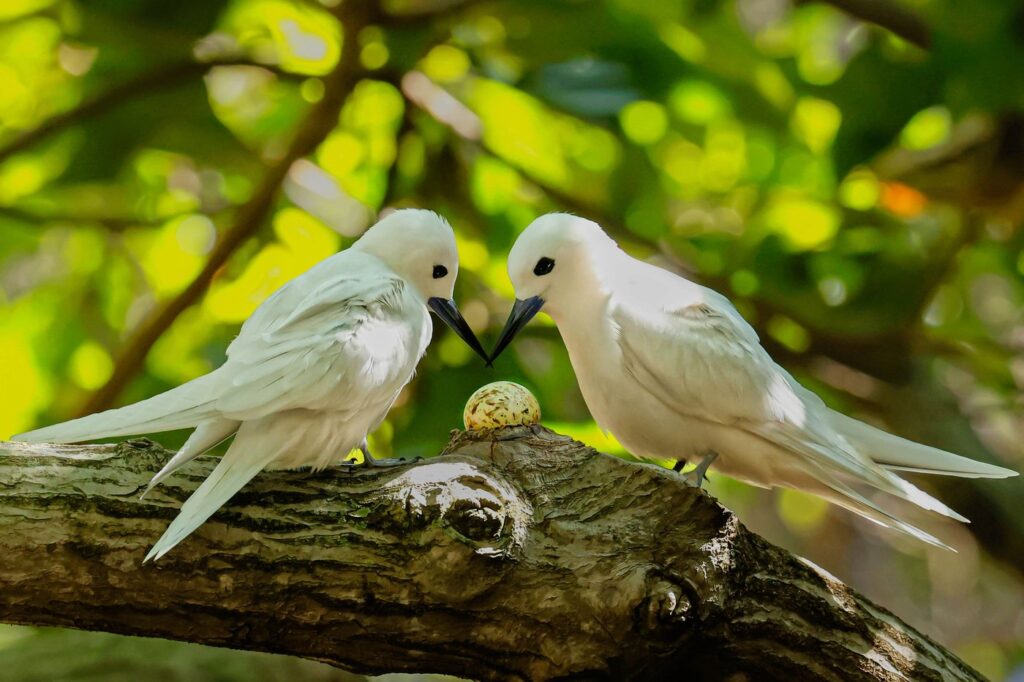
HONOLULU (AP) – Ka'iulani Murphy, a traditional navigator, has developed a keen ability to spot white terns while guiding Polynesian voyaging canoes across the Pacific Ocean. These birds, recognized for their hunting prowess at sea and nesting habits on land, signal to navigators like her that land is near. Recently, data has indicated a significant increase in the white tern population in Honolulu, with numbers rising by more than 50% over the past decade. This surge occurs amid the urban landscape of Hawaii's largest city, showcasing a stark contrast to the declining numbers of many other native birds in the region.
The presence of these seabirds in the bustling city of Honolulu is remarkable. Currently, as noted by Rich Downs, coordinator of the volunteer organization Hui Manu-o-Ku, there are 691 eggs and chicks reported in Honolulu's trees. The name "Manu-o-Ku" translates to "bird of Ku," referring to the Hawaiian god of war. While these birds can breed year-round, their activity peaks from winter to early spring. Uniquely, white terns do not construct traditional nests; instead, they lay their eggs directly on bare branches, ledges, or even window sills. This adaptation allows them to thrive despite the challenges posed by urban development.
White terns are typically found around the world in warm waters, but in Hawaii, they primarily inhabit remote atolls, with Oahu being an exception where they have settled among a large urban population. Scientists remain unsure why these birds are flourishing specifically in Honolulu. It is speculated that human activities, such as reducing the population of predators like rats and cats near urban areas, contribute to a safer environment for the terns. Additionally, the busy roads may deter certain predators, making the urban core a more favorable habitat.
According to Eric VanderWerf, the executive director of Pacific Rim Conservation, the urban environment with its noise and lights does not seem to disturb the white terns. Urban trees provide crucial habitats for these birds; the natural scars on well-maintained trees create havens for laying eggs. A recent survey by Hui Manu-o-Ku revealed that the population of breeding adult white terns in Oahu has increased 1.5 times since 2016, reaching approximately 3,600.
This growth underscores the challenges faced by Hawaii's native birds, as a significant number have gone extinct since human arrival—71 out of 113 species found solely on the islands. Many remaining species are classified as threatened or endangered and are often found in small populations in higher elevation forests. Although native to Hawaii, white terns were first observed breeding on Oahu in 1961 when scientists documented a pair with an egg.
Today, the white tern is recognized as Honolulu's official bird, a designation made in 2007. The species has become a symbol of pride within the community, with songs sung by schoolchildren and an annual festival celebrating their presence every May. To help protect these birds, Hui Manu-o-Ku staff mark trees hosting eggs and chicks with blue plastic ribbons, signaling tree trimmers to exercise caution. An online map further aids bird watchers in tracking these white terns.
Joyce Hsieh, a photographer, captures the life of these birds, documenting their incubation and nurturing of chicks. She often visits a Target parking garage, where she can easily access trees at the same level as the birds, enabling intimate observation. White terns, comparable in size to pigeons but with larger wingspans, can fly up to 120 miles from land in search of food, primarily small fish and squid.
For Murphy, a Native Hawaiian and traditional voyager, the flourishing of the white terns resonates with her cultural heritage. Just as these resilient birds adapt to their surroundings, so too have Hawaiians persisted despite historical adversities, including diseases introduced by Europeans in the 1800s. The parallels between the white terns and her people evoke a sense of connection, and encountering them during her voyages brings her joy, symbolizing a bond that transcends generations.








