

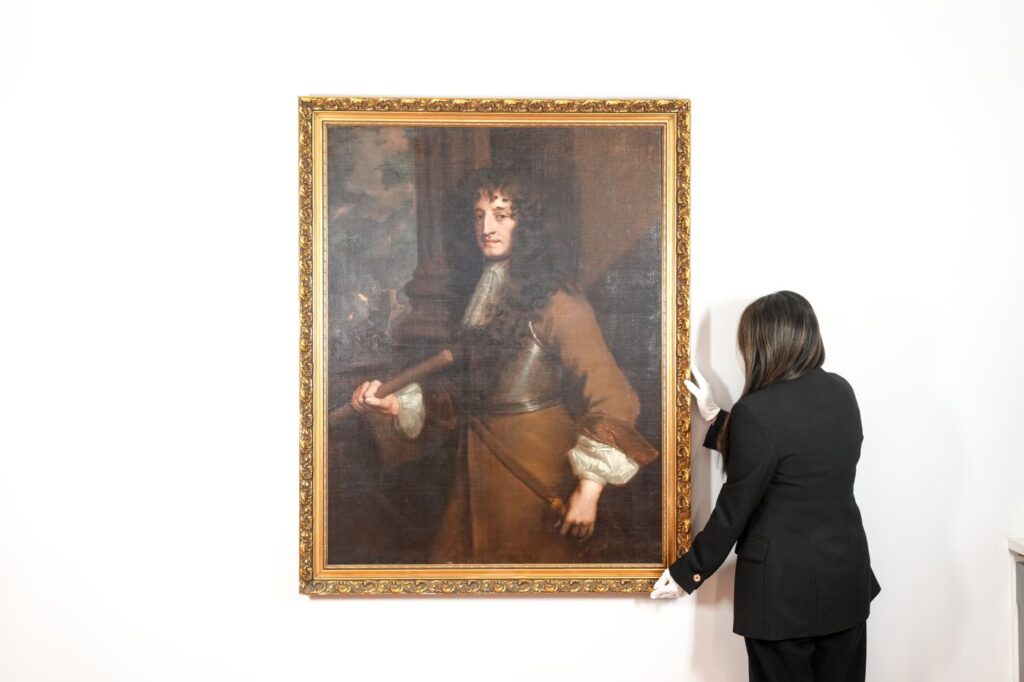
Heffel Fine Art Auction House recently discovered a remarkable painting that is now attributed to Sir Peter Lely rather than to the studio of Anthony van Dyck, as previously believed. The oil-on-canvas artwork, estimated to be from around 1665, features Prince Rupert, an influential figure who served as the first governor of the Hudson's Bay Company (HBC). His legacy includes a significant geographical expanse that constituted about 40 percent of Canada.
The portrait portrays Prince Rupert in a heavy coat and armored breastplate, holding a baton in one hand and a sword in the other, with a fierce battle scene unfolding in the background. Initially included in HBC’s art catalogue as a work from van Dyck’s studio, this painting sparked curiosity among Heffel's staff when it went up for auction last November. As bids increased, doubts began to surface, leading the team to conduct extensive research to determine its true artistic attribution.
Heffel Fine Art acquired the painting after HBC, facing bankruptcy and closing 80 of its department stores, tasked the auction house with selling its extensive art collection to help settle $1.1 billion in debt. During the initial auction in November, the price estimate for the Prince Rupert portrait ranged from $4,000 to $6,000. However, the impressive quality of the work led Heffel's team, which included trained painters, to question whether it should have been categorized as a studio piece.
David Heffel, the president of Heffel, made the decision to temporarily withdraw the painting from the auction to further investigate. The team consulted art historians, including David Franklin, an expert in Renaissance and Baroque art, who referred to the painting's brushwork as "spontaneous and audacious," prompting further exploration. Franklin pointed out an important detail: van Dyck passed away in 1641, while Prince Rupert, born in 1619, appeared significantly older than 22, which raised doubts about the original attribution.
The researchers uncovered historical documentation, including an 1821 letter from the HBC secretary that claimed the painting was by van Dyck. However, further investigation revealed that a 1932 exhibition identified the work as being created by Jacob Huysmans, and subsequent assessments from 1937 dismissed the connection to van Dyck, attributing it instead to Lely's style.
Franklin noted that a contemporary version of the portrait exists in Italy, and this version is recognized as a "fully autograph" work of Lely, meaning that it was created entirely by him without assistance. While such master copies with minor variations were common due to demand from aristocrats, Heffel's version of the painting contains distinctive elements that indicate it was likely not the result of a copyist's effort.
This new attribution to Peter Lely is significant, as it enhances the portrait's value and historical context. Franklin expressed an emotional connection to the work, emphasizing the importance of recovering an art piece with ties to Canadian history through HBC. For David Heffel, the discovery felt akin to winning the Stanley Cup, highlighting the rarity of correcting attributions of centuries-old artworks.
The reattributed Peter Lely portrait is scheduled for auction on May 21 during Heffel’s semi-annual event and is projected to fetch as much as $150,000 due to its grandeur and historical relevance. Previous auction results indicate that estimates can be conservative, with similar artworks exceeding their predicted values significantly. For instance, a portrait attributed to the school of Peter Lely sold for $15,000 despite being estimated at $6,000 in December.
David Heffel anticipates considerable interest in the upcoming auction, citing the painting's fascinating backstory that enriches its appeal. He remarked that this opportunity has provided a unique insight into art historical research, reflecting on the significance of uncovering the true origins of notable works.








