

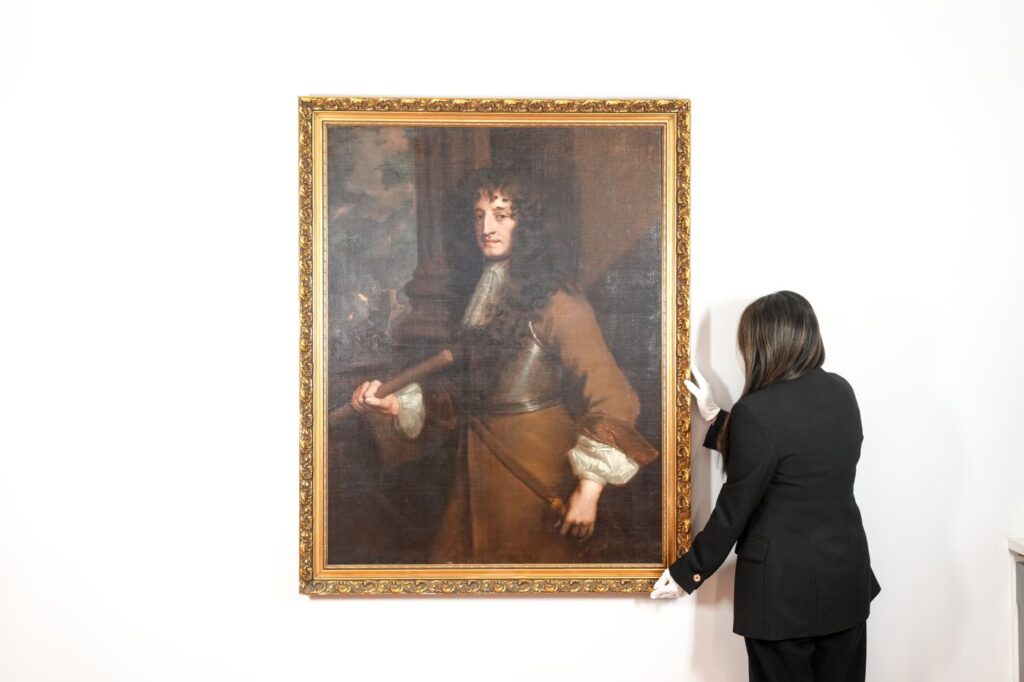
Heffel Fine Art Auction House recently faced an intriguing mystery while preparing to auction off treasures from the Hudson's Bay Company (HBC), Canada's oldest company. Among the art pieces was an oil-on-canvas portrait believed to depict Prince Rupert, the first governor of the HBC and a prominent figure during the English Civil War. The painting, estimated to date back to around 1665, features Prince Rupert clad in a heavy coat and armored breastplate, brandishing a baton and standing with a sword amid the turmoil of battle.
Initially, the painting was attributed to the studio of Anthony van Dyck, a renowned Flemish portraitist celebrated for his historical works. However, as the auction date approached in November 2025, Heffel's staff began to have doubts about this attribution, sparking a detailed investigation reminiscent of Sherlock Holmes. They decided to investigate the portrait further, postponing its sale to track its origins across Europe and North America.
After the HBC declared bankruptcy and closed its 80 department stores, it entrusted Heffel with the sale of over 4,400 pieces of art to alleviate its $1.1 billion debt. The Prince Rupert painting had been estimated to fetch between $4,000 and $6,000 during the initial sale, but its striking quality captured the attention of Heffel staff, prompting a deeper investigation into its true origins.
Heffel's president, David Heffel, called on art historians, including David Franklin, an expert in Renaissance and Baroque art. Franklin noted that the brushwork displayed was "spontaneous and audacious," leading him to conclude that it could not have been created by an assistant. Furthermore, he pointed out that van Dyck died in 1641, while Prince Rupert, the subject of the portrait, was born in 1619 and looked much older than 22 at the time of van Dyck's passing.
The research team uncovered an 1821 letter from the HBC secretary that claimed the painting had been a gift from the artist to the company shortly after its founding in 1670. Additionally, documentation indicated that the piece was first exhibited in 1932, where it was attributed to the Flemish painter Jacob Huysmans but later linked to Peter Lely, a renowned Dutch portraitist and the principal painter for King Charles II.
In later findings, researchers discredited the van Dyck attribution, aligning it with Lely's distinct style. Franklin argued that the classification of Lely should never have been in doubt, citing the existence of a later version of the painting in Italy that exhibited Lely's signature characteristics. The differences between the two versions include subtle variations in attire, yet both adhere closely to the authentic style of the master painter.
The evidence gathered led Heffel to confidently reattribute the painting to Peter Lely. Franklin expressed emotional satisfaction in deciphering a connection to a 17th-century artist. David Heffel likened the excitement of this discovery to "winning the Stanley Cup in Game 7," emphasizing the rarity of correcting a centuries-old attribution in the art world.
The reattributed Peter Lely portrait is expected to be auctioned on May 21, 2026, during Heffel's semi-annual auction. It will be sold as the only HBC piece in the event, carrying an updated estimated value of up to $150,000. Given the intriguing backstory and the grandeur of the artwork, expectations are high for significant interest from bidders. Heffel anticipates that this opportunity for research and discovery within art history may not arise again, suggesting a major milestone in the field.








