

HONG KONG (AP) – Asian shares experienced a mostly positive trading session on Wednesday, bolstered by significant gains in Japan and South Korea. This uptick coincided with a slight decline in oil prices despite ongoing geopolitical tensions marked by various attacks executed by Iran against its Gulf neighbors. U.S. futures also showed a rise of 0.4%, following a day of moderate gains on Wall Street. Investors are particularly attentive to the Federal Reserve's impending decision regarding interest rates, scheduled for later in the day.
With elevated oil prices contributing to inflationary pressures, analysts generally anticipate that the Fed will opt to maintain current interest rates. Concerns regarding global oil and gas supplies, coupled with fluctuating prices, continue to pose challenges for international markets. In this context, Brent crude, the international oil benchmark, recorded a 2.3% decline, settling at approximately $101 per barrel, down from over $106 earlier this week. Similarly, U.S. benchmark crude saw a more than 3% drop, priced at $93.17 per barrel.
On Wednesday, Iran launched multiple attacks on its neighboring Gulf countries and Israel, a response to the recent killing of a prominent Iranian leader in an airstrike. The assaults utilized some of Iran's advanced missile capabilities, successfully bypassing air defenses and resulting in casualties near Tel Aviv. Despite these escalations, global markets appeared to absorb the news without significant reaction.
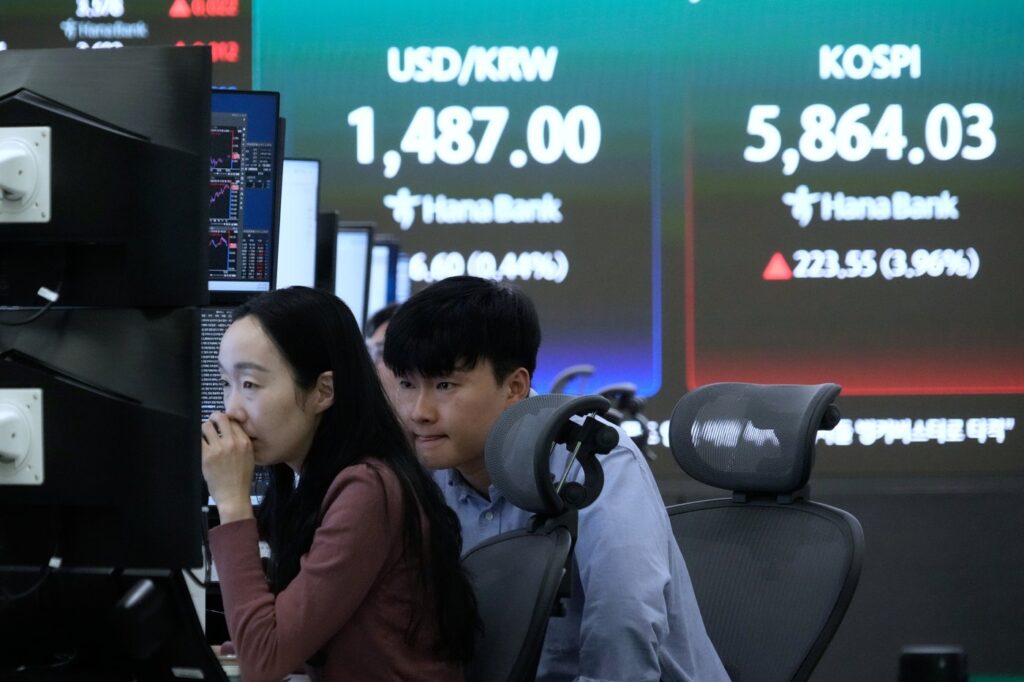
In Japan, the Nikkei 225 index surged by 2.6%, closing at 55,106.69, bolstered by better-than-expected export figures released by the government for February. South Korea's Kospi experienced an impressive jump of 3.8%, reaching 5,854.28. Notably, lower oil prices tend to benefit major oil-importing nations like Japan and South Korea.
However, not all Asian markets followed this upward trend. The Hong Kong Hang Seng index saw a minor decrease, losing 0.2% to settle at 25,816.92, while the Shanghai Composite index slipped 0.5% to reach 4,028.94. In Australia, the S&P/ASX 200 managed a modest increase of 0.5%, achieving a closing value of 8,653.40. Taiwan's Taiex index moved up by 1.3%, and India's Sensex also recorded a 0.6% gain.
Oil prices continued their downward trajectory on Wednesday after earlier gains. Brent crude was reported to have dropped by 1.2%, reaching $102.22 per barrel, down from its earlier levels above $106. Meanwhile, benchmark U.S. crude fell by 1.8%, trading at $94.49 a barrel. Analysts from ING Bank, Warren Patterson and Ewa Manthey, noted in their research that global oil flows remain largely constrained. However, there is growing optimism surrounding the possibility that Iran may begin allowing more vessels to pass through the Strait of Hormuz, a crucial passage for global oil and gas transportation.
The Strait of Hormuz is significant, as it accounts for roughly one-fifth of the world's crude oil transportation. Iran had previously claimed to be restricting U.S., Israeli, and allied access to this vital passage. On Tuesday, the U.S. stock market remained relatively stable, with the S&P 500 rising by 0.3% to 6,716.09. Additionally, the Dow Jones Industrial Average slightly increased by 0.1%, culminating at 46,993.26, while the Nasdaq composite saw a 0.5% rise, reaching 22,479.53.
In early trading on Wednesday, Delta Air Lines shares rose by 6.6% following an upward adjustment to the company’s revenue forecast, attributed to a strong anticipated demand that could help mitigate increased jet fuel costs driven by the conflict in Iran. Similarly, Uber Technologies stock climbed by 4.2%, fueled by the announcement of an expanded partnership with chipmaker Nvidia aimed at launching an autonomous vehicle fleet in the U.S., starting in San Francisco and Los Angeles next year.
In the foreign exchange market, the U.S. dollar dipped to 158.85 Japanese yen, down from 159.01 yen. Meanwhile, the euro was trading at $1.1539, a slight decrease from $1.1542 earlier.








