

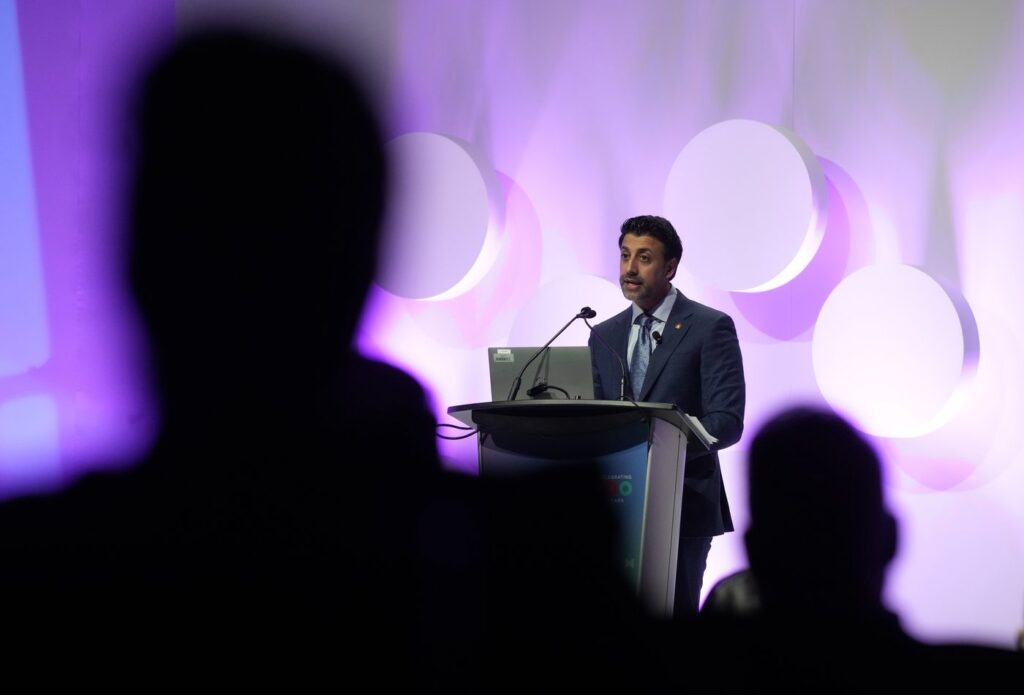
OTTAWA – Canada’s International Trade Minister Maninder Sidhu recently announced the government’s intention to finalize three significant trade agreements by the end of the year, focusing on Mercosur, the Association of Southeast Asian Nations (ASEAN), and India. In an interview with The Canadian Press, Sidhu detailed the ongoing diplomatic efforts with teams of negotiators actively engaging in discussions around the world almost every week.
This past week, a Canadian negotiating team was in Brazil to advance talks on a free-trade agreement with Mercosur, the South American trade bloc comprised of Argentina, Bolivia, Brazil, Paraguay, and Uruguay. Sidhu expressed optimism about wrapping up these agreements, especially those involving India and ASEAN, which includes 11 member states in Southeast Asia.
A recent update from the Prime Minister's Office highlighted a discussion between Prime Minister Mark Carney and Argentina's President Javier Milei. During this conversation, both leaders recognized progress in trade negotiations, with Carney emphasizing Canada’s significant investment role in Argentina’s mining sector and exploring opportunities for a broader partnership in areas such as trade, critical minerals, energy, and investment.
The Canadian government, under the Liberal administration, aims to double non-U.S. exports over the next decade. In the government’s spring economic update, it was noted that non-U.S. goods and services exports had increased by $33 billion in 2025 compared to 2024, a development Sidhu described as “very promising.” Additionally, Carney's government has celebrated the signing of 20 strategic trade and defense agreements globally over the past year, reflecting a proactive stance in international trade.
Since March 2025, Carney has visited 25 countries during 17 international trips, including significant stops in China and India, two nations that have experienced strained relations with Canada recently. Indian Commerce Minister Piyush Goyal is expected to lead “one of the largest delegations” to Canada at the end of May, which Sidhu confirmed would follow up on Canada’s recent trade mission to India.
While expressing hope for timely negotiations, Sidhu acknowledged the complexities involved, stating, “We’re negotiating as fast as possible,” but emphasized that the process requires time, especially with a country as populous and diverse as India. He pointed out that Indian companies are keen on investing in Canadian energy and mining initiatives, noting India’s projected energy needs—70% more by 2040—which Canada is well-positioned to help fulfill.
Furthermore, Sidhu highlighted that India has substantial demand for uranium and potash, suggesting a mutually beneficial relationship between the two countries. He mentioned India's recent trade agreements with the European Union, the United Kingdom, and New Zealand and stressed the importance of keeping Canadian businesses competitive in this evolving landscape. “To remain competitive, we must continue exploring a free trade agreement with India,” he stated, reinforcing the necessity for continued delegations to facilitate growth in trade.
Finally, Sidhu reiterated that the Canadian government's objective is not merely to sign agreements but to secure the best possible conditions for Canadians. He emphasized the importance of achieving “real wins,” ensuring that any agreement genuinely benefits Canadian interests rather than being a formality.








