

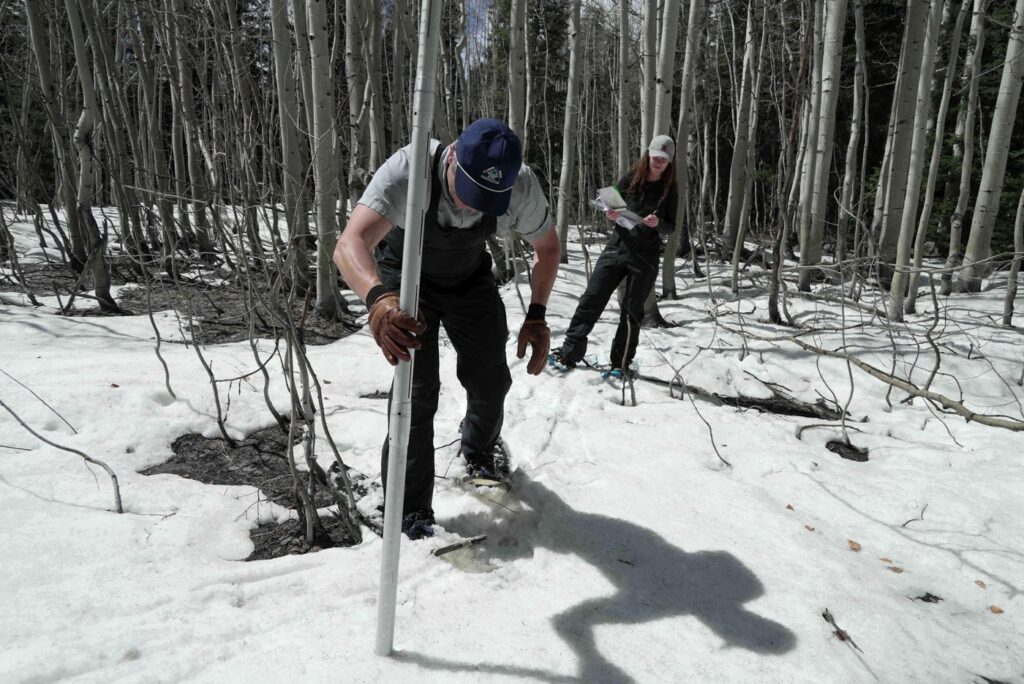
WALDEN, Colo. (AP) – This winter, Colorado experienced its worst snowpack on record since statewide measurements began in 1941, according to hydrologist Maureen Gutsch. The troubling scenario is exacerbated by the fact that mountain snow accumulations peaked a month early, containing only about half the average moisture. A warm winter transitioning into early springtime record heat has led to the rapid disappearance of snow at all but the highest elevations in the western United States. This situation poses a significant risk of worsening water shortages, further aggravating the ongoing significant drought unless an unexpected deluge occurs.
As Gutsch surveyed the Rocky Mountains, specifically the headwaters of the Colorado River, she noted the disconnect between the sunny 56-degree Fahrenheit (13.3 degrees Celsius) weather and the dismal snowpack conditions. Despite her dedication to measuring snow, this year's findings brought a sense of depression. Recent assessments by the U.S. Department of Agriculture’s Natural Resources Conservation Service confirmed the record-low snowpack, raising concerns among city officials about impending water restrictions and farmers about adequate feed and water for their cattle, alongside the looming threat of devastating wildfires.
Ranchers in Colorado’s mountain valleys, close to the melting snowpack, are often the first to feel the effects of drought. Philip Anderson, a retired teacher and lifelong rancher in North Park valley, expressed his concerns, stating he has never seen such warmth this early in the year with little to no snowfall throughout the winter. Typically, he would expect to see snow lingering on his pastures until spring, aiding in grass growth and refilling stock ponds. However, with the absence of snow, his cows are grazing prematurely, and several ponds are dry, severely impacting his ranching operations.
Anderson's ranch sits at an elevation of roughly 8,100 feet (2,500 meters), where snowfall is normally abundant during late winter and early spring. However, this drastic change in weather patterns has resulted in less available water, with nearby ditches running dry and only available to those with more senior water rights. In 2002, Anderson faced a similar crisis, forcing him to haul water and sell part of his cattle herd.
Meanwhile, Jo Stanko, another rancher along the Yampa River, reported that low water flows are forcing her to water her meadow earlier than ever in her half-century of ranching experience. She is now considering purchasing hay to sustain her 70 cows, a costly decision influenced by the prevailing drought conditions. The ongoing struggle for water resources has led to an old saying in the West: “whiskey's for drinking and water's for fighting over,” a sentiment that rings true amid the protracted drought partly driven by climate change.
The Upper Basin states of Colorado, New Mexico, Utah, and Wyoming find themselves at an impasse with Lower Basin states such as Arizona, California, and Nevada as negotiations continue regarding new rules for managing water during shortages. With current regulations set to expire in September, time is running short. Federal plans have drawn criticism, particularly from Arizona's Democratic Governor Katie Hobbs, who stated the proposals unfairly placed the burden on her state. Upper Basin states claim they are already using significantly less water than they are entitled to under existing agreements due to honoring senior water rights, many dating back to the 1880s.
As communities grapple with limited water supplies, cities like Salt Lake City have announced a 10% daily reduction in water use, with restrictions becoming mandatory for the largest non-residential users. On the opposite side of the Rockies, Denver Water approved lawn watering limits and aims for a 20% reduction in water use. With Denver’s water supply heavily reliant on snow-fed streams from the mountains, water managers stressed the urgency of preserving what little water remains, especially given the ongoing dry conditions.
As the threat of wildfires escalates, areas beyond the Rockies, including California, are also feeling the effects of below-average snowpack. Drought conditions pose an increased risk, and while cooler, wetter weather may provide temporary relief, the long-term outlook remains grim without significant and sustained rainfall. Ranchers like Anderson advocate for collaboration among water rights holders to navigate the current crisis and ensure equitable access to scare resources. With conditions becoming increasingly dire, the urgency to address the ongoing drought and its consequences cannot be overstated.








