

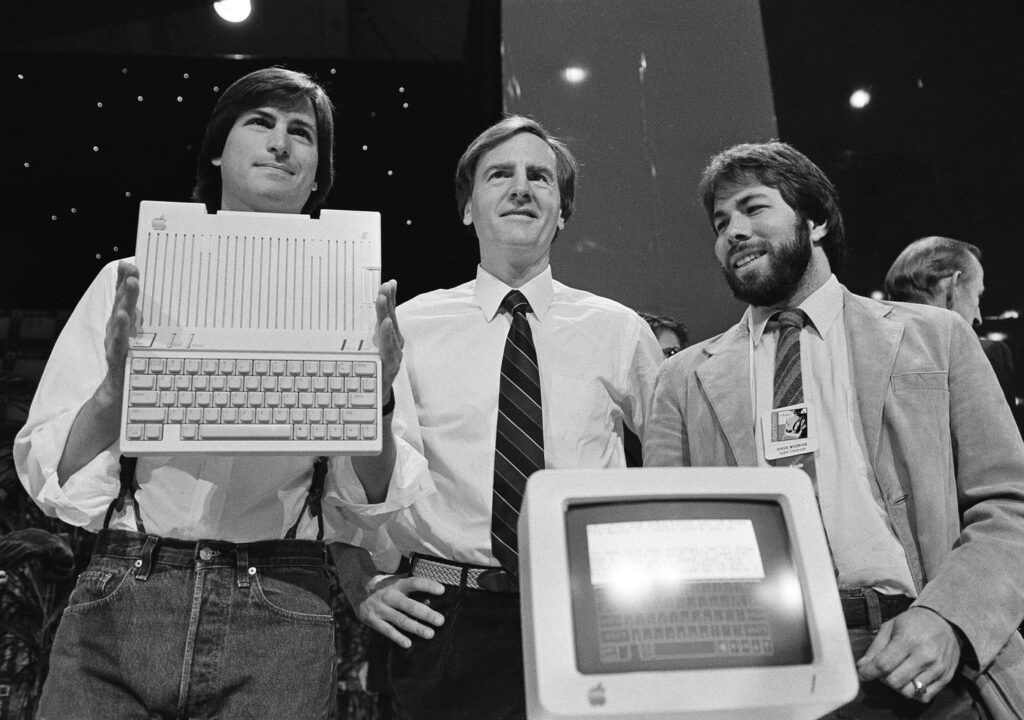
On April 1, 1976, in Cupertino, California, a partnership was formed between two unlikely friends, Steve Jobs and Steve Wozniak, who would go on to change the tech landscape forever. Jobs, a 21-year-old college dropout, paired with Wozniak, a 25-year-old Hewlett-Packard engineer, led to the creation of Apple Computer Co. Their venture began with a modest two-page partnership agreement, with each co-founder obtaining a 45% share, while Ron Wayne, their adviser, received the remaining 10%. However, Wayne would later relinquish his stake for $2,300, a decision that would cost him dearly, as Apple’s market value currently stands at approximately $3.7 trillion.
The initial phase of Apple was fraught with challenges, particularly in their mission to develop a personal computer in the Los Altos home of Jobs' parents. Despite early struggles, Apple found its footing by releasing the Apple II in June 1977, priced at $1,298 (equivalent to around $7,000 today). This marked the company's first significant success. Following a successful public offering in late 1980 at $22 per share, Apple shares, adjusted for stock splits, would yield over $5.5 million for an early $2,200 investment in 100 shares.
Jobs’s theatrical unveiling of the Macintosh on January 24, 1984, was a pivotal moment for the company. He showcased a revolutionary product that introduced the computer mouse and a graphical user interface to a broader audience. This presentation coincided with a now-iconic Super Bowl ad directed by Ridley Scott, which created a cultural milestone by promoting the Macintosh in a manner that transformed future advertising practices.
Despite its innovative features, the Macintosh, priced at $2,500 (nearly $7,900 today), didn't meet sales expectations. Following disappointing sales, CEO John Sculley implemented layoffs and cost-cutting measures, further straining his relationship with Jobs. By September 1985, a power struggle culminated in Jobs's resignation, leaving a vacancy that would lead to a troubled period at Apple.
Post-Jobs, Apple faced intense challenges as it struggled to maintain its market share against more affordable PCs running Microsoft software. The competitive pressure escalated, leading to a protracted legal battle over the Macintosh's graphical interface. This turmoil resulted in the dismissal of Sculley in mid-1993, followed by Michael Spindler and then Gil Amelio in 1996, as the company grappled with significant financial losses.
A turning point came in 1997 when Jobs, having returned as an adviser, took the helm after Amelio's dismissal. His leadership was marked by reconciliation with Microsoft’s Bill Gates, leading to a pivotal $150 million investment that facilitated the launch of the iMac. Jobs’s vision for Apple shifted with the introduction of the iPod in October 2001, fundamentally altering the music industry and paving the way for digital music consumption.
On January 9, 2007, Jobs introduced a groundbreaking product: the iPhone, combining a digital music player, mobile phone, and internet communicator into one device. Since its release, over 3 billion units have been sold, making the iPhone a cornerstone of Apple’s revenue model, contributing to over half of its annual earnings of $416 billion.
Under the stewardship of Tim Cook, who inherited a legacy from Jobs, Apple’s market value soared to ten times what it was at the time of Jobs's passing. Though Cook has faced the challenge of not launching another blockbuster product akin to the iPhone, Apple continues to thrive, demonstrating the lasting impact of Jobs's visionary approach and the company’s commitment to innovation.








