

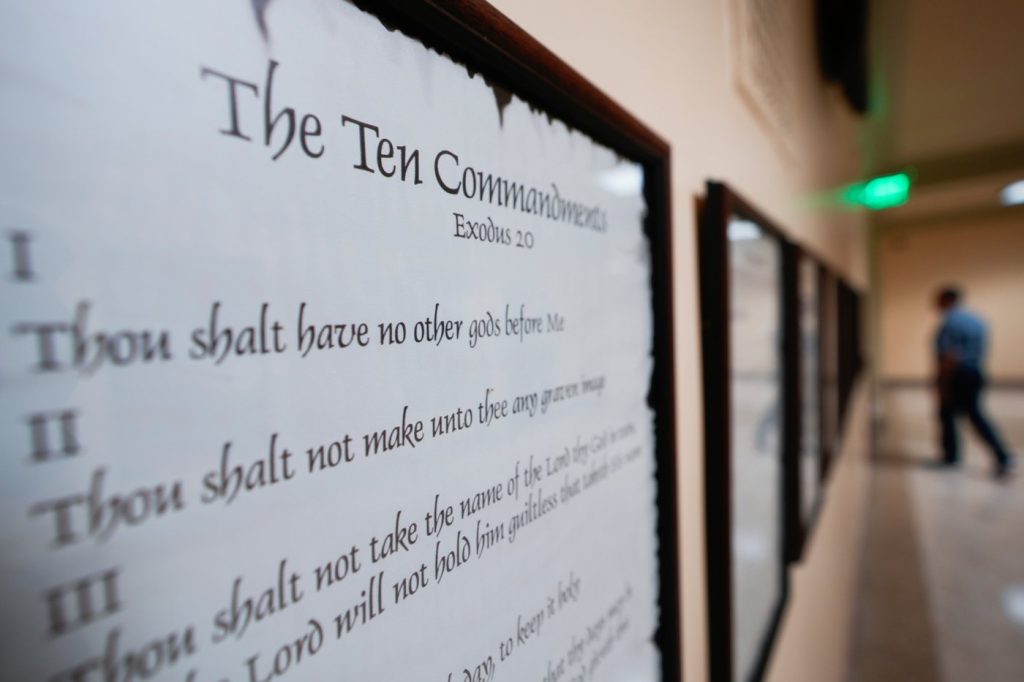
A U.S. appeals court has allowed a Louisiana law mandating the display of poster-sized Ten Commandments in public school classrooms to come into effect. The ruling was issued by the 5th U.S. Circuit Court of Appeals, which voted 12-6 to lift a lower court's injunction that had blocked the law since 2024. The court indicated that it was premature to assess the constitutionality of the law, primarily due to uncertainties regarding how prominently the religious text would be displayed, whether educators would reference the Ten Commandments during instruction, and if other historical texts, such as the Mayflower Compact or the Declaration of Independence, would also be included.
The majority opinion emphasized that without specific details, the court lacked sufficient information to evaluate any First Amendment implications that might arise from the law. It noted that the situation required more concrete facts to facilitate judicial evaluation rather than speculative interpretations. In his concurring opinion, Circuit Judge James Ho, appointed by former President Donald Trump, stated that the law is not only constitutional but also represents the nation's highest and most noble traditions.
Conversely, the six dissenting judges expressed concern that the law potentially exposes children to government-endorsed religion in a mandatory educational environment, this presenting a clear constitutional burden. Circuit Judge James L. Dennis, appointed by former President Bill Clinton, articulated that the law embodies the exact establishment of religion that the Framers of the Constitution aimed to prevent.
This ruling follows a reevaluation of the case by the full panel of judges after a prior three-judge decision in June deemed the Louisiana law unconstitutional. The reversal is notable given that the 5th Circuit is recognized as one of the nation's most conservative appeals courts, often promoting Republican policies that align with those of the U.S. Supreme Court. Louisiana's Republican Governor, Jeff Landry, celebrated the court's decision, proclaiming, "Common sense is making a comeback!"
In reaction, the ACLU of Louisiana, representing the plaintiffs in the case, has vowed to pursue all legal avenues to challenge the law further. Other states, including Arkansas and Texas, have enacted similar laws requiring the display of the Ten Commandments in public schools. In Arkansas, the law is currently under federal court scrutiny, while a Texas law took effect on September 1, leading to widespread distribution of the posters in several school districts. Despite some Texas districts facing injunctions that prevent them from displaying the posters, many have found ways to implement them either through private donations or self-funded printing.
These legislative initiatives are part of a broader trend among Republicans, including former President Trump, to integrate religious elements into public education. Critics argue that such moves contravene the principle of separation of church and state, whereas supporters claim that the Ten Commandments represent a historical foundation of U.S. law.
Joseph Davis, an attorney representing Louisiana in this case, praised the court's ruling for affirming America's tradition of embracing faith in public spaces. Families from diverse religious backgrounds, along with various clergy members and secular families, have raised challenges against these laws. The Freedom From Religion Foundation, which also opposed the law, described the decision as "extremely disappointing," stating that it puts families in a position where they must repeatedly challenge displays in different school districts.
After the ruling, Louisiana Attorney General Liz Murrill indicated that guidance had been provided to schools about the appropriate format for the required posters. Historically, the U.S. Supreme Court has ruled against similar laws; in 1980, it declared a Kentucky statute unconstitutional due to its lack of secular purpose, which primarily served a religious agenda. Similarly, in 2005, the Court found that Ten Commandments displays in Kentucky courthouses violated constitutional principles while allowing a Ten Commandments marker at the Texas state Capitol.








