

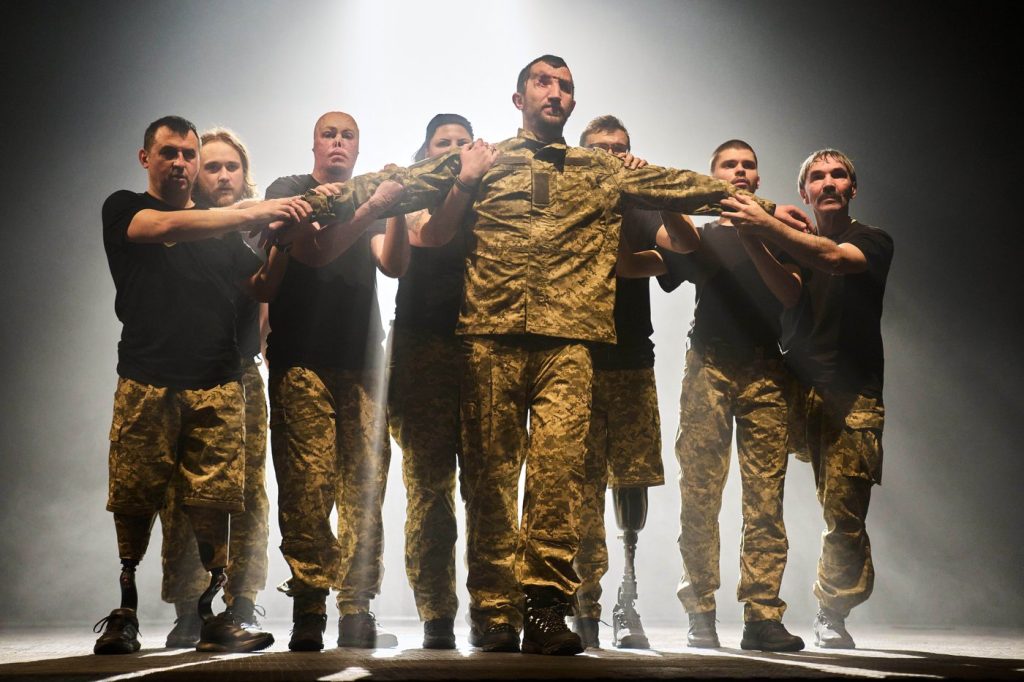
KYIV, Ukraine (AP) — The day before the opening night of a unique theatrical production, Ukrainian war veterans and drama students gathered in a circle to read their lines from a script that embodies resilience and hope. The heart of this innovative endeavor is Olha Semioshkina, who directed an adaptation of “Eneida” by Ivan Kotliarevskyi, an 18th-century Ukrainian reinterpretation of Virgil's “Aeneid.” This production brings a contemporary message about resilience amid a war that has now extended into its fourth year since Russia’s full-scale invasion on February 24, 2022.
The cast included men and women aged from their 20s to 60s, featuring military veterans who returned from the front with life-altering injuries such as amputations, severe burns, and sight loss. Many among them had never stepped on a stage before participating in this play. It took over a year to prepare for the much-anticipated premiere at Kyiv’s National Academic Molodyy Theatre, underscoring the effort invested in this project.
According to Semioshkina, the initial phase involved teaching participants to communicate and interact again. She emphasized the importance of learning foundational skills, stating, “We spent about four months simply learning to communicate, to fall, to group, to roll, to get together.” The goal was to develop their physicality and overcome the challenges posed by their injuries, including learning to act without prosthetics when necessary.
In her conceptual framework, every male actor represents Aeneas, and every female actor embodies Dido. Aeneas, famously depicted in Virgil’s epic as a wandering Trojan hero in search of a new homeland, is morphed into a relatable Cossack in Kotliarevskyi's adaptation, reflecting the earthy and vibrant characteristics of Ukrainian culture. In this modern retelling, Aeneas sports prosthetic limbs and visibly bears the scars of war, embodying the struggles faced by Ukrainian soldiers.
Semioshkina noted the parallel between the veterans' experiences and the journey of Aeneas, highlighting how both experience trauma but continue to pursue their ambitions. “Aeneas is a hero who goes through a lot in search for his land,” she stated, emphasizing his relentless spirit despite the horrors he faces.
During rehearsals, Yehor Babenko, a veteran of Ukraine’s Border Service with severe burns from the early days of the invasion, infused humor into the heavy material, stating, “Feeling burned out at work? We have a lot in common.” His poignant monologue later revealed personal struggles akin to Aeneas’s journey, resonating deeply with the audience.
Babenko shared how performing in the play has become a form of rehabilitation for him, enhancing his public expression and physical awareness. He stressed the story of Aeneas as particularly relevant to contemporary Ukraine, which is grappling with the notion of searching for its own place in the wake of conflict.
In a poignant twist, the play's final act diverged from traditional epic storytelling to allow the actors to share their personal wartime experiences, covering themes such as combat injuries, the trauma of displacement, and stories of loss and survival. One veteran recounted losing a leg to a drone strike, while another, a female medic, reflected on returning to the frontlines in her 60s after enduring years of war since Russia's annexation of Crimea in 2014.
Andrii Onopriienko, who lost his vision during a Russian artillery strike, narrated much of the performance, bringing a powerful presence to the stage. Initially hesitant to join the project due to his blindness, he ultimately found healing and connection through the rehearsal process, emphasizing the joyful environment it provided.
Despite the ongoing war and its disruptions, including air raid alerts, the premiere managed to captivate audiences. The production creatively integrated the challenges faced by the actors, using prosthetics strategically within the performance. When a power outage occurred mid-play, Semioshkina and the cast adapted seamlessly, using flashlights to maintain the performance, delivering an emotional moment that resonated deeply with the audience.
As the play concluded to a standing ovation, Semioshkina sent an uplifting message to veterans at home: “Come out. You can do something. Live. Don’t close yourself off. Live every single minute.” This theatrical project stands not just as a reflection of historical struggles, but also as a beacon of hope and humanity amid the backdrop of ongoing conflict.








