

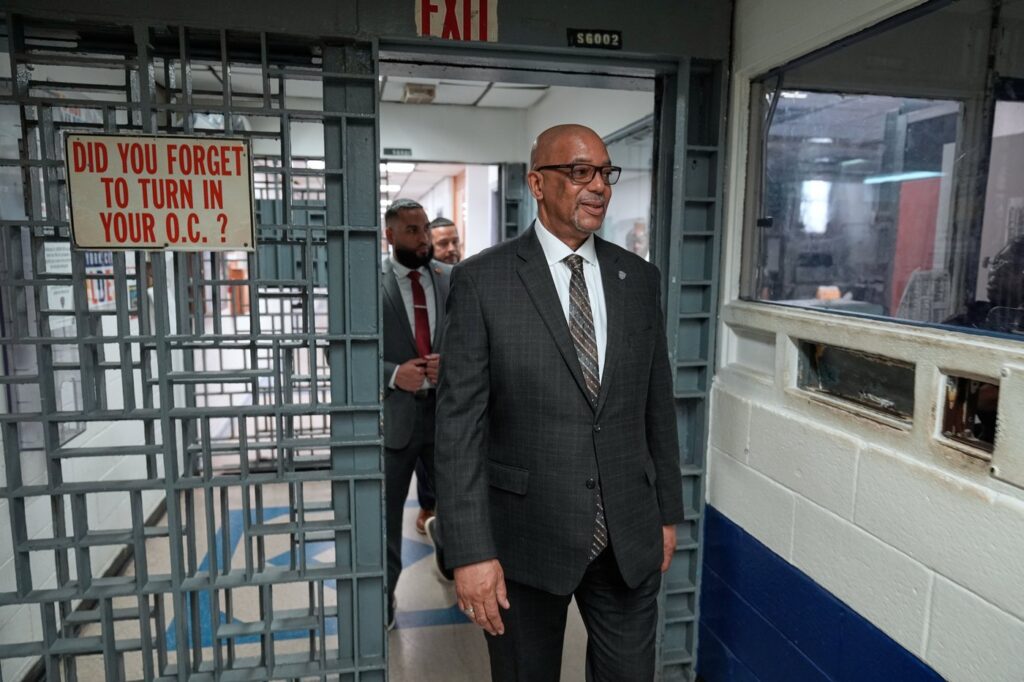
Stanley Richards, now the commissioner of the New York City Department of Correction, has a personal history that profoundly informs his leadership role at Rikers Island, the infamous jail complex where he was once incarcerated for robbery as a young man. Appointed by Mayor Zohran Mamdani in January, Richards made history as the first formerly incarcerated individual to oversee the city's jails.
Richards reflects on his past during a recent visit to his old cell, a 10-by-7-foot space characterized by graffiti and a sealed window. He does not harbor negative feelings regarding his past, stating, "I offended my community and committed a crime, and I paid my price for it. The truth of my story is a story of redemption." At 65 years old, he now leads the Department of Correction at a pivotal time for the troubled jails system.
In response to ongoing issues at Rikers, including violence and concerns regarding inmate health care, a federal judge appointed a remediation manager in January to help restore order. Last year alone, 15 individuals died while in the Department of Correction custody, primarily due to medical issues, as reported by the Vera Institute of Justice. Furthermore, a city law mandates the closure of Rikers and the relocation of inmates to four smaller facilities by 2027, a deadline that is fast approaching.
Richards’ life trajectory—from being an inmate to working as a counselor for released inmates—equips him with a unique perspective on correctional challenges. After his 1991 release from prison, he joined the Fortune Society, a nonprofit focused on inmate reintegration, eventually rising to the position of CEO before taking on roles within the Correction Department under former Mayor Bill de Blasio.
His appointment as commissioner sends a powerful message that dignity in treatment does not conflict with community safety. Ben Heller from the Vera Institute emphasizes that Richards’ lived experience positions him to understand that incarceration alone cannot ensure safety. As commissioner, Richards has committed to collaborating with Nicholas Deml, the newly appointed federal overseer of Rikers, to create safer jail environments.
Richards has acknowledged challenges in closing Rikers, recognizing the timeline as "practically impossible." Despite opposition from former Mayor Eric Adams regarding the closure, the city has initiated steps toward that goal, such as opening a new jail unit in Bellevue Hospital to house over 100 individuals with acute medical conditions and serious mental health issues.
Another crucial aspect of Richards’ plan includes addressing the existing violence within the jails by filling approximately 1,300 staff vacancies, which contribute to unsafe conditions and rising overtime costs. He aims to introduce new programs designed to prepare inmates for life after incarceration while adhering to a city law that limits the use of solitary confinement—an approach opposed by Adams.
Richards plans to work with court officials and prosecutors to streamline case processing, aiming to reduce the time individuals spend at Rikers awaiting trial, and to safely manage those eligible for diversion programs outside of jail. He believes that focusing on these strategies will lead to a decreased inmate population over time.
Richards, along with his team, is determined to change the narrative surrounding Rikers Island, emphasizing the need for compassion and care within the correctional system. "This has been a system that society has said, 'Out of sight, out of mind,'" he stated. "Those days are over. We’re gonna walk in the light. We’re gonna lift this place up." His commitment to transforming the environment at Rikers is underscored by his understanding of its complexities, both as a former inmate and a dedicated professional in the correctional field.








