

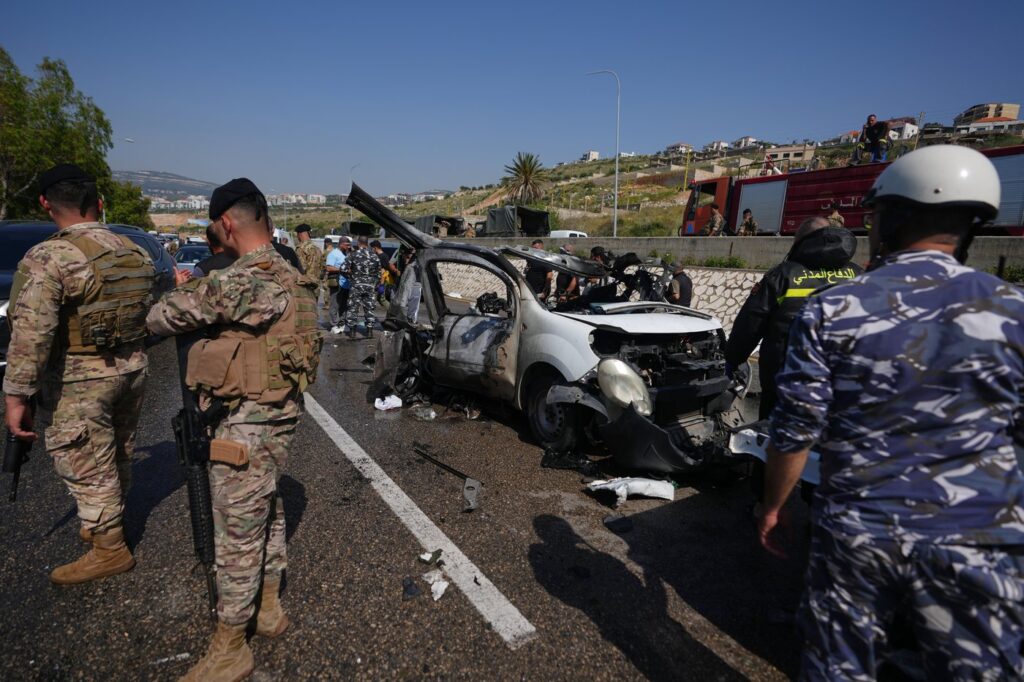
BEIRUT (AP) – On Saturday, Israeli drone strikes targeted vehicles south of Beirut, resulting in the deaths of four individuals. Concurrently, multiple airstrikes across southern Lebanon claimed at least 13 lives, among them a man and his 12-year-old daughter, according to reports from state media and the Lebanese Health Ministry. These recent developments mark a significant escalation of violence in the region, which has seen both Israel and Hezbollah continue their military operations despite a ceasefire that took effect on April 17.
The three drone strikes occurred along a highway connecting Beirut to the port city of Sidon, causing numerous injuries. A third strike was reported on a road leading to the Chouf region, where three people were killed, as reported by the state-run National News Agency (NNA). An Associated Press journalist confirmed the presence of a deceased individual on the highway in the town of Saadiyat. The Health Ministry's preliminary reports indicated that an Israeli airstrike in the village of Saksakiyeh killed at least seven people, including a child, while injuring 15 others.
In additional reports, the agency highlighted strikes that resulted in fatalities in southern Lebanon, including three deaths in the village of Bourj Rahhal and one in Maifadoun. Notably, the Health Ministry also reported three drone strikes that killed a Syrian father riding a motorcycle alongside his daughter in the city of Nabatiyeh. Following the initial strike, the father and daughter managed to escape but were targeted again, leading to the death of the father and, subsequently, the daughter in the hospital due to her injuries. The Ministry condemned these actions as "barbaric targeting" and raised concerns over violations of International Humanitarian Law.
The Israeli military reported that Hezbollah had fired explosive drones into Israeli territory, resulting in injuries to three soldiers, one of whom was severely wounded. Additionally, Hezbollah conducted drone strikes within Lebanon, targeting an Israeli vehicle without causing any casualties. The organization also claimed several assaults inside Lebanon and reported launching a drone at an Israeli military installation in Misgav Am.
This resurgence of conflict can be traced back to March 2, when Hezbollah initiated hostilities by firing rockets into northern Israel, following a series of operations launched by the U.S. and Israel against Iran, a key supporter of Hezbollah. In response, Israel has conducted numerous airstrikes and has launched a ground invasion of southern Lebanon, capturing several towns and villages along the border. In light of the escalating situation, Lebanon and Israel engaged in their first direct talks in over three decades despite their long-standing state of war initiated with the establishment of Israel in 1948.
Future discussions are planned in Washington, set to commence on Thursday over two days. A ceasefire negotiated in Washington first took effect on April 17 and was later extended by three weeks. Amid these developments, Lebanese Prime Minister Nawaf Salam conducted talks in Damascus with Syria's interim President Ahmad al-Sharaa. They emphasized strengthening relations between Lebanon and Syria and enhancing security cooperation in the context of ongoing regional conflicts. Salam stressed Lebanon's commitment not to become a battleground against its Arab neighbors, particularly Syria, in reference to Hezbollah's involvement in the Syrian civil war since its inception in 2011.








