

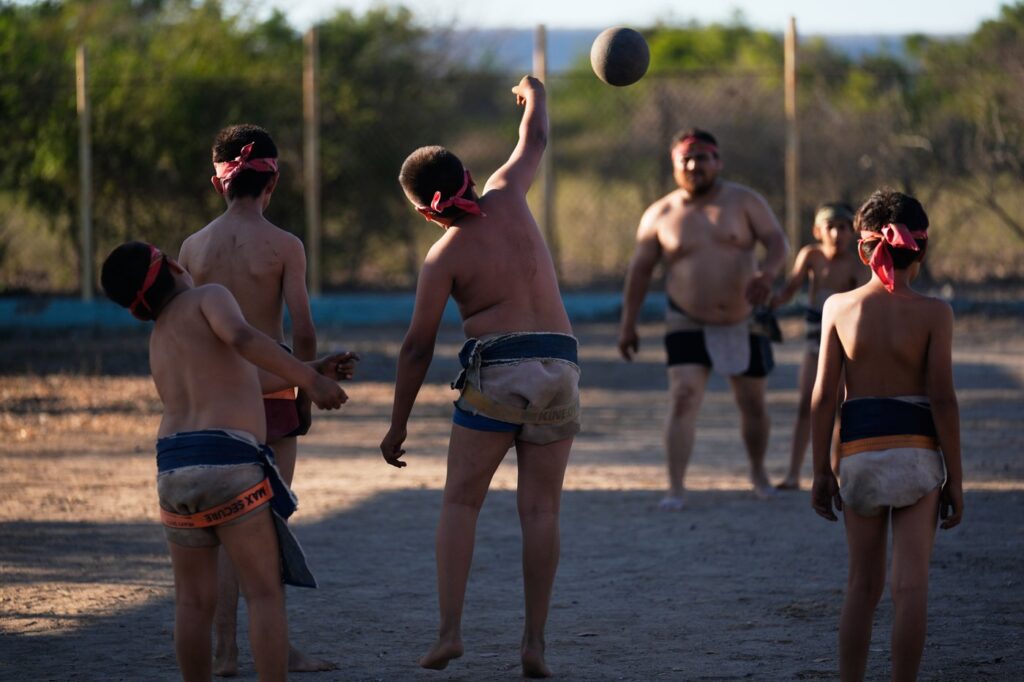
LOS LLANITOS, Mexico (AP) — On a dirt field on Mexico’s Pacific coast, five cousins, ages 8 to 13, prepare to play ulama, an ancient pre-Hispanic ballgame. The children strip down, kick off their shoes, and have adults help them fasten their traditional attire known as the "fajado," which consists of loincloths and leather belts. They grab a 3.2-kilogram rubber ball, which is approximately seven times heavier than a soccer ball, and begin their game, where only the hips may make contact with the ball, requiring players to leap and dive to keep it in play.
As Mexico readies to co-host the 2026 FIFA World Cup, the nation is revisiting its sporting heritage dating back over 3,400 years to ulama, a game nearly erased during the Spanish conquest. Surviving only in remote areas of northwestern Mexico, ulama has experienced a revival in the late 20th century. Modern players and authorities are now leveraging the momentum of international soccer to promote this ancient sport.
While the resurgence of ulama has brought some attention and growth, players express concerns that casting the sport in an "exotic" light undermines its cultural significance. Emilie Carreón, a researcher at the National Autonomous University of Mexico (UNAM), highlighted the necessity of moving beyond the notion that ulama is merely a "living fossil." This belief is central to the efforts of the Osuna family, who are dedicated to preserving their heritage through this game. Following the death of ulama player Aurelio Osuna, his widow María Herrera has taken it upon herself to teach their grandchildren the sport in their small village in Sinaloa, located 1,000 kilometers (620 miles) northwest of Mexico City.
The cultural roots of ulama can be traced to the Popol Vuh, the sacred Mayan text, which describes the creation of the world through a ballgame where opposing forces contend. Known to have been played as far back as the Olmec civilization, ulama has a rich history depicted in ancient codices, stone carvings, and sculptures. It has been played in various forms, serving different societal functions, from fertility or war ceremonies to entertainment and potential sacrifices. Although some players may have faced beheadings, this was limited to specific times and regions.
The Spanish conquest led to the banning of ulama, with conquistadors viewing the game as a symbol of resistance against Christianity. Elements of ulama survived mainly on Mexico's northern Pacific coast, where the colonial Jesuit priests were less aggressive in suppressing indigenous practices. By the time of the 1968 Mexico City Olympics, ulama was demonstrated as a spectacle, leading to renewed interest and efforts to study and preserve it.
Today, the Osuna family continues the tradition, teaching new generations the intricacies of the game. Luis Aurelio Osuna, 30, following in his father’s footsteps, instills passion for ulama in his three children. He emphasizes the need to divert youth from the temptations of organized crime in Sinaloa and believes ulama provides a constructive outlet.
Ulama matches, once robust events tied to religious feasts, have decreased in frequency and scale. Efforts in the 1980s to document the last rubber ball-makers in Sinaloa reveal the commitment to maintaining the sport's tools of play. In the 1990s, the tourism sector sought out Sinaloan families to represent ulama as an attraction, allowing the game to gain broader recognition, albeit often in a commercialized fashion.
As the 2026 World Cup approaches, ulama players are increasingly featured in advertising campaigns. However, this commercialization stirs mixed feelings among players. Ángel Ortega, a 21-year-old from Mexico City, asserts that they are not mere attractions—"circus monkeys." Ilse Sil, a participant in the UNAM project, advocates for institutional support to preserve ulama while encouraging grassroots promotion in local communities and schools. Presently, there are approximately 1,000 ulama players, primarily based in Mexico and Guatemala.
In Los Llanitos, María Herrera’s grandchildren remain passionate about ulama, playing whenever and wherever they can—with a treasured, handmade rubber ball from Sinaloa. Eight-year-old Kiki dreams of leading his own team someday, embodying hope for the sport’s future.








