

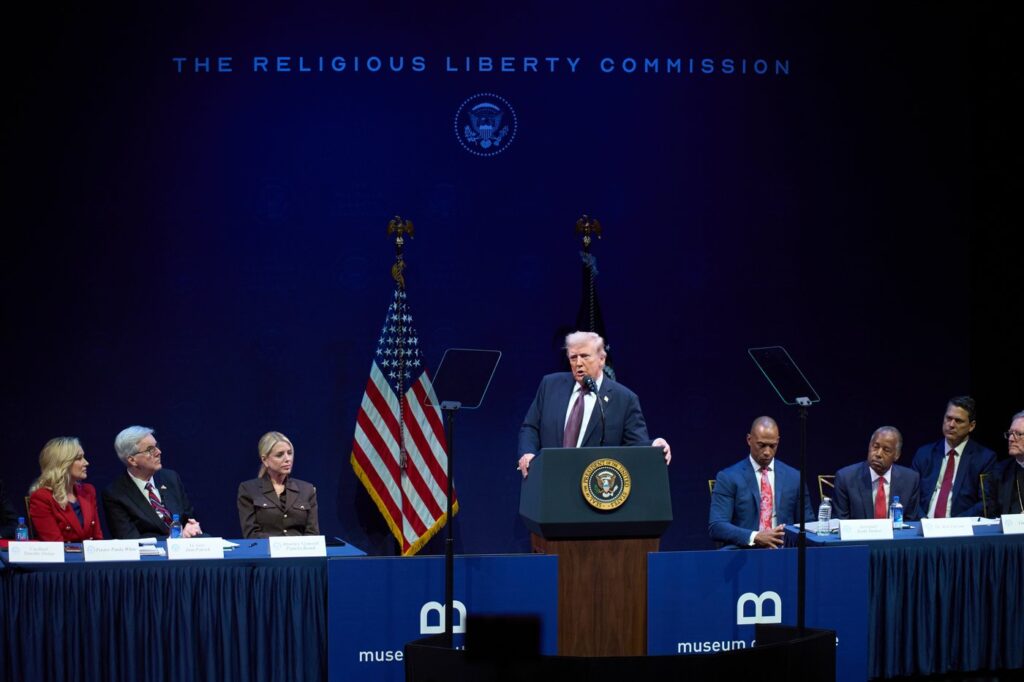
A recent meeting of President Donald Trump's advisory panel, the Religious Liberty Commission, highlighted a range of controversial recommendations from its members, most of whom are drawn from his conservative Christian base. Among the proposals discussed was a call for a Presidential Medal of Freedom for a baker who declined to create a wedding cake for a same-sex couple, alongside suggestions for federal intervention in lawsuits involving Amish parents resisting New York vaccine requirements and Catholic nuns contending with state mandates regarding gender identity accommodations in hospice care.
The commission, which was established to explore issues of religious liberty, is preparing its final report. During a meeting in April, members expressed a unified stance on their wish list, which reflects a broader conservative perspective aimed at enhancing religious expression in schools, increasing funding for faith-based organizations, and expanding exemptions based on religious beliefs across various sectors, including healthcare and employment.
Critics argue that the commission embodies a narrow viewpoint aligned with Trump's supporters and jeopardizes the established separation of church and state. A lawsuit filed by a progressive interreligious coalition contends that the commission violates federal law mandating diverse representation, citing that most members are conservative Christians with only a single Orthodox Jewish rabbi present. It is noted that most meetings have been held at the Museum of the Bible in Washington, a site led by Christian governance.
In response, the Republican administration is pushing for the dismissal of the lawsuit, citing procedural technicalities and maintaining that the law does not define how commissions should ensure a balanced representation of viewpoints.
In a related development, the Task Force to Eradicate Anti-Christian Bias, another initiative from Trump, produced a report alleging discrimination against Christians during President Joe Biden's administration. However, progressive organizations criticized this report, labeling it as advocacy with no substantive proof of systemic discrimination and focusing instead on issues that align with conservative ideological tenets.
Within the commission, disagreements are uncommon, though one notable exception arose when Carrie Prejean Boller was ousted following a contentious discussion on antisemitism. Prejean Boller, who defended controversial commentator Candace Owens, claimed her dismissal stemmed from expressing her beliefs, while Commission Chair Dan Patrick accused her of attempting to dominate the hearing.
Despite the overwhelming agreement within the commission's ranks, some accounts have revealed that witnesses have testified about experiences where they felt their conservative religious values clashed with workplace regulations. Various commissioners advocated for specific rights, including posting the rights of religious expression in schools and workplaces, restoring full benefits to military personnel discharged over vaccine refusals, and allowing religious groups to receive federal funding without compromising their beliefs.
Patrick has publicly denounced the notion of a separation between church and state, championing for the inclusion of religious practices in public education. He emphasized the need to counter efforts aimed at removing religious expressions from public life, rallying for an affirmation of faith in the public sphere.
Others, like Bishop Robert Barron from the Catholic Diocese of Winona-Rochester, focused on securing humane treatment for detained immigrants and ensuring religious organizations can maintain their doctrinal integrity while receiving federal funds. Legal professionals, including Kelly Shackelford of the First Liberty Institute, have also pushed for systemic changes that would enable individuals facing religious liberty challenges to have their legal costs covered by government entities after a loss in court.
The ongoing discussions within the Religious Liberty Commission exemplify the complex intersection of faith, policy, and societal values in contemporary America, posing challenging questions about the balance between religious expression and state governance.








