

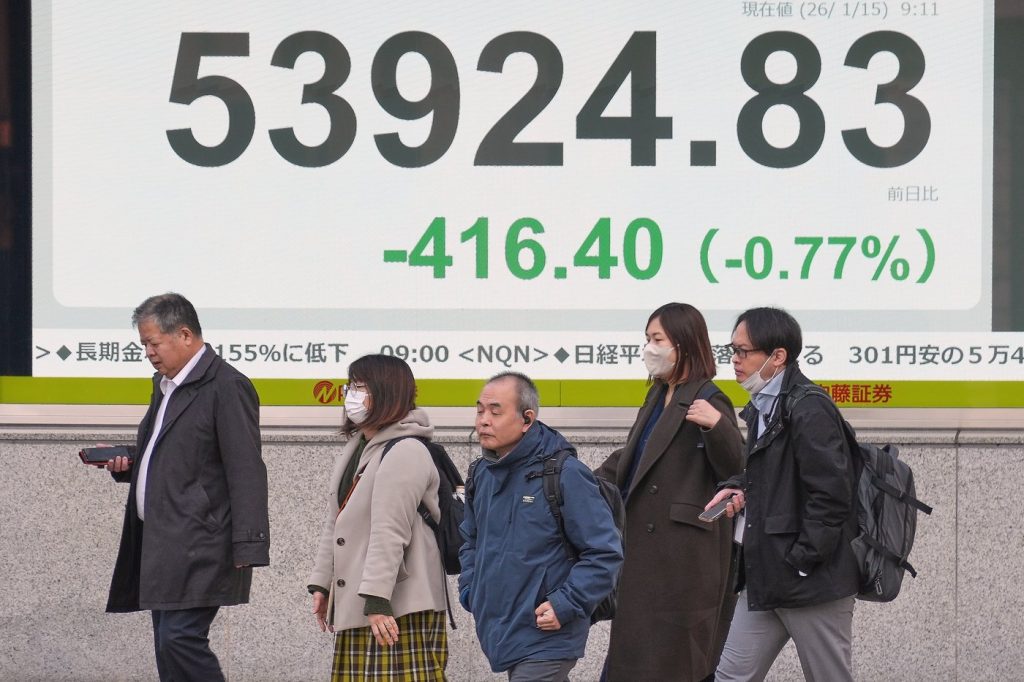
HONG KONG (AP) - Asian stocks mostly declined, and U.S. futures also dropped on Thursday following a retreat on Wall Street, primarily influenced by falling Big Tech shares. Investors appeared to be recalibrating their positions amidst concerns regarding overvaluation and the recent hype surrounding artificial intelligence.
In the commodities market, oil prices witnessed a notable decrease, falling more than $2 a barrel after U.S. President Donald Trump stated he received credible information that plans for executions in Iran had been halted. This statement came despite Tehran indicating that it would proceed with swift trials and executions as part of its crackdown on protesters. U.S. benchmark crude dropped by $2, or 3.3%, to $59.88 per barrel, while Brent crude, the international standard, fell $2.12, or 3.2%, to $64.40 per barrel.
Turning to Asian markets, Japan's Nikkei 225 index fell 0.9% to 53,863.84, with technology-related stocks underperforming. Major players such as SoftBank Group decreased by 5.6%, Advantest saw a 4.1% drop, while chip maker Tokyo Electron declined by 3.3%. Conversely, shares of Toyota Industries rose by 6% after it was reported that Toyota Motor increased its buyout offer for the company to 18,800 yen ($118.61) per share.
In Hong Kong, the Hang Seng index dropped by 0.6% to 26,850.78. Significant losses were observed in shares of Trip.com, a Chinese online travel platform, which plummeted over 20% after Beijing launched an antitrust investigation into the company. The Shanghai Composite index followed suit, declining by 0.6% to 4,101.52. On a more positive note, South Korea's Kospi saw a slight increase of 0.5% to 4,747.85, and Australia's S&P/ASX 200 rose by 0.3% to 8,851.00. Meanwhile, Taiwan's Taiex index fell by 0.6% amid anticipation that Taiwan Semiconductor Manufacturing Company (TSMC) would report strong quarterly profits in its earnings announcement on Thursday.
U.S. futures for the S&P 500 and the Dow Jones Industrial Average were down by 0.1%. On the previous day, the S&P 500 experienced a dip of 0.5%, settling at 6,926.60, marking its second consecutive loss. The Dow Jones fell by 0.1% to 49,149.63, while the Nasdaq composite decreased by 1% to 23,471.75. Big Tech stocks weighed heavily on the market performance, despite the fact that a majority of stocks on Wall Street saw gains. This trend was partly attributed to a dwindling enthusiasm for AI-related investments, coupled with critical assessments suggesting that these stocks had reached unsustainable valuations.
Specifically, shares of Nvidia declined by 1.4%, while chip manufacturer Broadcom experienced a more significant drop of 4.2%. Additionally, shares from various banks took a hit; Wells Fargo saw a significant decline of 4.6% following a report revealing weaker-than-expected quarterly profit and revenue. Similarly, Bank of America and Citigroup reported decreases of 3.8% and 3.3%, respectively.
Despite the overall downturn, shares of Exxon Mobil and other oil companies provided some resistance to heavier losses for the S&P 500, with Exxon Mobil rising by 2.9% and Chevron increasing by 2.1%. Amid elevated geopolitical uncertainties, investors turned towards safe-haven assets. Gold prices fell back slightly by 0.8% but remained close to their previous record levels.
In the bond market, the yield on the U.S. 10-year Treasury fell to 4.14%, down from 4.18% late Tuesday, as investors favored safer investments. Generally, bond prices rise as yields fall. Concurrently, early Thursday dealings saw the dollar rise to 158.63 Japanese yen from 158.46 yen, while the euro was trading at $1.1636, down from $1.1645.








