

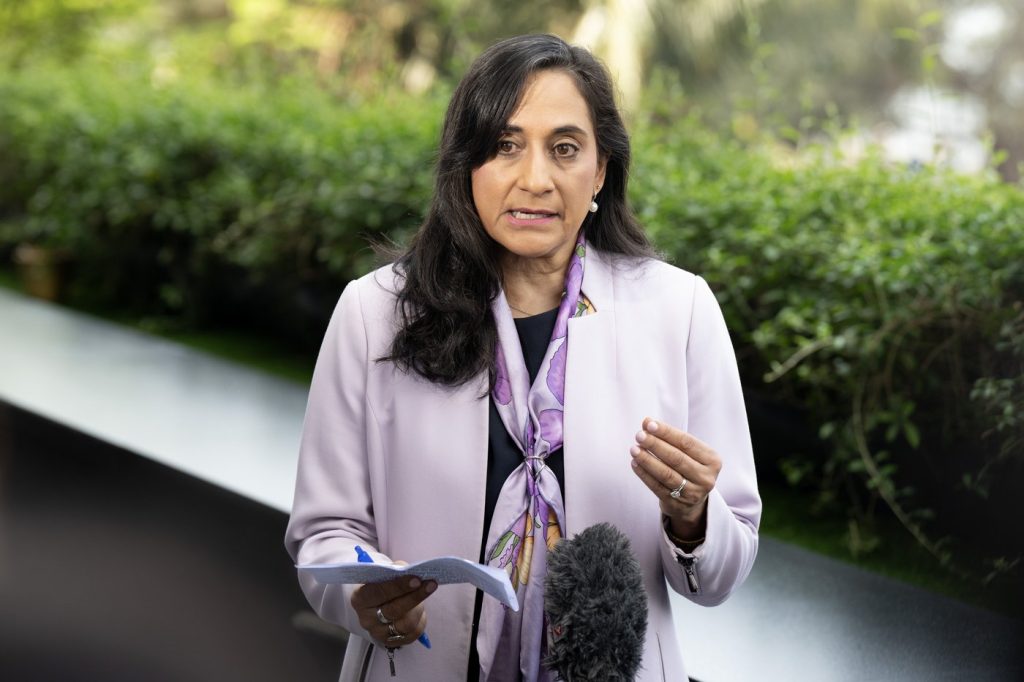
MUMBAI – Canadian Foreign Affairs Minister Anita Anand has condemned the recent attacks by Iran against Canada’s partners in the Middle East, specifically calling for an end to such aggression. In a series of online statements, Anand expressed her solidarity with the United Arab Emirates as it defends itself amid escalating tensions fueled by Iranian actions, particularly focusing on developments concerning Qatar.
The urgency of her comments came just after the confirmation of the death of Iran's Supreme Leader, Ayatollah Ali Khamenei, due to a military strike from American and Israeli forces targeting Iran. Anand is currently in Mumbai, accompanying Prime Minister Mark Carney, who held discussions with key figures from the Indian Oil sector and Coal India to foster bilateral trade relations.
During his visit, Carney articulated Canada's ambition to establish a comprehensive trade agreement with India, aiming to double the two-way trade volume by the year 2030. After concluding his meetings in Mumbai, he is scheduled to travel to New Delhi. This trip marks a significant effort in re-establishing and strengthening trade and diplomatic relations between Canada and India.
Despite the critical geopolitical developments following Khamenei’s death, neither Anand nor Carney has publicly commented on this matter. However, prior to the confirmation, Carney had voiced his support for U.S. actions in Iran, clarifying that Canada would refrain from direct involvement in the ongoing conflict. Anand emphasized that Canada would continue to support its citizens in the region and advised Canadians present in Iran to find safe shelter until the situation stabilizes.
In retaliation to recent military incursions, Iran has countered with missile and drone strikes targeting Israel, along with attacks on U.S. military sites in Bahrain, Kuwait, and Qatar. At a public event, Carney described Iran as the "principal source of instability and terror throughout the Middle East," reiterating the necessity of preventing Iran from acquiring nuclear weapons.
U.S. President Donald Trump defended the military operations against Iran, asserting that the country has persisted in advancing its nuclear program and developing missiles capable of reaching U.S. territory. Trump also highlighted grievances that have persisted since the establishment of the Islamic Republic. Carney revealed that he and his finance and foreign affairs ministers have engaged in several discussions with Trump and U.S. officials regarding the potential for military intervention if diplomatic solutions were to falter.
Experts have raised concerns about the security implications of Canada's backing for U.S. military action, warning of potential retaliatory measures from the Iranian regime against perceived adversaries abroad. Thomas Juneau, an assistant professor at the University of Ottawa, pointed to a troubling pattern of “transnational repression,” wherein Iran targets Iranian-Canadian dissidents and activists promoting human rights and democratic values.
Security analyst Sajjan Gohel remarked that, feeling cornered, the Iranian state might escalate its cyberwarfare tactics given the high stakes it now faces. He noted that the regime appears to consider itself in an existential battle, facing possible elimination with little left to lose.
Historically, Iran and its allied factions have launched numerous attacks against distant adversaries, employing state-sponsored cyberwarfare to surveil and intimidate dissidents residing in Canada, the U.S., the U.K., Germany, and beyond. Notably, in 2024, the Canadian House of Commons condemned an alleged Iranian plot aimed at assassinating former Liberal justice minister Irwin Cotler, highlighting the persistent threats posed by the Iranian regime.
This unfolding geopolitical situation underscores the volatile nature of international relations in the region and raises pressing questions about the future of Canadian foreign policy vis-a-vis Iran and its allies.








